Saturday, May 09, 2009

Weekend pictures

These photos were taken along the ridge line between the Cedar Creek and Forked River watersheds travelling along the Wells Mill swamp, New Jersey. The result of ice age glacial activity, the Forked River mountains are large sand and gravel mounds deposited by ancient rivers during the retreat of the glaciers thousands of years ago. Subsequent rising and falling sea levels submerged the entire area leaving behind sand, silt and swampy lands.


Friday, May 08, 2009

Face

Young migratory mother, originally from Texas. On the day before the photograph was made she and her husband traveled 35 miles each way to pick peas. They worked 5 hours each and together earned $2.25. They have two young children... Live in auto camp - Dorothea Lange. Photographed by Dorothea Lange (1895-1965) on April 11, 1940. Image from World Digital Library.

Prayer: Public/Private

Hilzoy on Obama's recent decision to not hold a ceremony for the National Day of Prayer, preferring instead to pray in private

I would think that people of faith, in particular, should be wary of politicians holding ceremonial observances of National Prayer Day. For one thing, one's communications with God are intensely personal. If you think of God as a person, and not as a political weapon, the idea of having a ceremony of this kind would be like observing National Have A Serious Talk With Your Spouse Day by having such a talk in front of TV cameras. 

Quotable

From an interview of computer scientist Leslie Lamport.

Question: You have always been a member of an industrial research lab. What is the difference between an industrial research lab and a university department?

Leslie Lamport: Jean Renoir wrote in his autobiography that someone once asked his father, the painter Auguste, why he painted from nature. Renoir père answered that if he were to try painting a tree in the studio, he would be able to draw four or five different kinds of leaves, and the rest would all look like them. But nature creates millions [his count] of different kinds of trees. I like working in industry for the same reason Renoir liked to paint from nature.

via Artblog. 

Thursday, May 07, 2009

Polyamorism watch

As states in the north-east strikes up one legislative victory after another in the arena of gay rights, the next ones in line may be polyamorists - or threesome marriage partners demanding their rights... 

Less than 18 months ago, Sasha Lessin and Janet Kira Lessin gathered before their friends near their home in Maui, and proclaimed their love for one another. Nothing unusual about that—Sasha, 68, and Janet, 55—were legally married in 2000. Rather, this public commitment ceremony was designed to also bind them to Shivaya, their new 60-something "husband."
... Unlike open marriages and the swinger days of the 1960s and 1970s, these unions are not about sex with multiple outside partners. Nor are they relationships where one person is involved with two others, who are not involved with each other. That's closer to bigamy. Instead, triads—"triangular triads," to use precise polyamorous jargon—demand that all three parties have full relationships, including sexual, with each other.
Heinz Pinggera, The Harem, oil on canvas, 29" X 39"

Good riddance already?

Time magazine gets tough on the Republican party and its ideals... They seem to predict that the end is almost near. I would prefer the party still lurk in the background serving us a constant reminder of the depths a nation could plumb. On the other hand, what will we do without the constant entertainment from the honorable Mr. Rush if the party fades away...

The party's ideas — about economic issues, social issues and just about everything else — are not popular ideas. They are extremely conservative ideas tarred by association with the extremely unpopular George W. Bush, who helped downsize the party to its extremely conservative base. A hard-right agenda of slashing taxes for the investor class, protecting marriage from gays, blocking universal health insurance and extolling the glories of waterboarding produces terrific ratings for Rush Limbaugh, but it's not a majority agenda. The party's new, Hooverish focus on austerity on the brink of another depression does not seem to fit the national mood, and it's shamelessly hypocritical, given the party's recent history of massive deficit spending on pork, war and prescription drugs in good times, not to mention its continuing support for deficit-exploding tax cuts in bad times.
Eugene Remy Maes (1849 - 1931), 'The Cock Fight', oil on canvas, 35" X 47"

Quotable

Hal Niedzviecki, a Toronto-based author of the book "The Peep Diaries" spins the Facebook status update craze. Hilarious.

"There's a certain charm to status updates of 'I'm making soup.' These things have a beauty to them because they're little domestic details of our lives, once upon a time we lived in villages and everybody knew that someone was making soup. Now we live in isolation. If you look at it positively, you say, 'These are ways to alleviate the loneliness and return to a more communal time.' In certain ways you could say that these are anti-narcissistic gestures, they're gestures of community that bring us together."
Ward Sutton's cartoon in the May 11, 09' issue of the New Yorker magazine. More of his work here.

Wednesday, May 06, 2009

Painting Post

'Gypsy', 80" (height) X 68" (width), oil on gessoed canvas, 2009

Readings in hegemony

A story of Diego Garcia. I must say that after reading this, the connections between the words 'United States' and 'veiled colonialism' are stronger... 

It is a story of an old empire passing the torch to the new, Britain handing over one of its furthest-flung territories to the United States and expelling the native inhabitants to make way for the construction of a military base that has since become central to US control of the Indian Ocean and domination of the Persian Gulf. It is the tale of how a remote island idyll was simply emptied of its people, allowing for the creation of a place so secret that no journalist has been allowed to visit, a key staging post in George W. Bush's war on terror, both the launch pad for the B-1s, B-2 "stealth" bombers, and B-52s that pounded Afghanistan and Iraq and a crucial node in the CIA's rendition system, a "black site" through which at least two high-value suspected terrorists were spirited, far from the prying eyes of international law.   ...He argues that there are at least sixteen such cases, where "often in isolated locations, often on islands, and often affecting indigenous populations, the US military has displaced local peoples" to make way for bases or similar activity. They range from the Bikini Atoll, picked for a nuclear test, to Koho'olawe, Hawaii, taken after Pearl Harbor; from Guam, of which the US military controls around one third, to the Philippines, where "Clark Air Base and other US bases were built on land previously reserved for the indigenous Aetas people." The Navy pushed aside Aleutian islanders in Alaska, Puerto Ricans from the small island of Vieques, and Inughuit people from Danish Greenland—to say nothing of the 250,000 people displaced by the US base in Okinawa, fully half of the island's population.
Louis Onesime, originally from Diego Garcia, and who has lead an uncertain life in exile following the removal of islanders from the Chagos Archipelago by the British in 1971, sits in the house he shares with 26 other family members in Port Louis, Mauritius, 17 January 2005. Photo and text from here.

Eco reads

A first rate essay on reproductive timing and interdependencies among species in nature.

The winter moth caterpillar is partial to the leaves of apple and cherry trees, but any deciduous tree will do. Around Arnhem, in the Netherlands, it feeds on oak leaves. But the caterpillar has a delicate timing problem: it must hatch just when the new leaf buds burst open, revealing the young leaves. If it hatches too early, or too late, it may starve. Too early, and there are no leaves to eat; too late, and increased tannin concentrations make the leaves less digestible. Either circumstance leads to a lower weight at pupation or to a longer larval period, resulting in a higher probability of the caterpillar’s being eaten. The date of the oak bud burst is cued largely by spring temperatures and can vary considerably from year to year. There is strong selection pressure on the winter moth to synchronize its egg hatching to the oak bud burst. But the moth’s timing mechanism is determined by the relationship between frost-days (below 0°C, or 32° F) and those days with a temperature above 3.9°C (39° F), rather than mean temperature alone.
... Those organisms that succeed will be the ones with the flexibility to change and adapt to the new temporal regime faster than the speed of the changes in seasonal timing. Some species may migrate poleward. Others may move to higher altitudes. But complete communities will not simply move north or south in synchrony with changing temperatures. Instead, the blend of plants and animals will change. Climate change could create ecosystems that are unknown today. We do not know what plants and animals they will contain. We do not know what will result when the temporal webs that connect plants and animals are broken. It may be that generations to come will see nature’s wonders. But it is more likely that much of the awe and wonder that obtain from the diversity of life on earth that we know at present will be lost.

Tuesday, May 05, 2009

Webby!

Webby winners here.

Gawker's take is worth noting... 

Among the inside crowd, the Webby Awards were always a joke, a masquerade where Internet fanboys and fangirls played dress-up and feigned the red-carpet rituals of Hollywood's real ceremonies. But somewhere along the way, the organizers figured out that this goofy charade could be milked for profit. And now that mainstream entertainers like Jimmy Fallon and Seth McFarlane are sweeping this year's awards, the parodic circle is complete.

Toon


More cartoons from Mike Peters of the Dayton Daily News here.

'Geniuses are not born, but made' department

David Brooks on the '10,000 hours of practice to become a genius' theory...  Here, he applies the hard work theory to developing a 'genius writer'. In an age of Obama, this column seems apt.

If you wanted to picture how a typical genius might develop, you’d take a girl who possessed a slightly above average verbal ability. It wouldn’t have to be a big talent, just enough so that she might gain some sense of distinction. Then you would want her to meet, say, a novelist, who coincidentally shared some similar biographical traits. Maybe the writer was from the same town, had the same ethnic background, or, shared the same birthday — anything to create a sense of affinity. This contact would give the girl a vision of her future self. It would give her a glimpse of an enchanted circle she might someday join. It would also help if one of her parents died when she was 12, infusing her with a profound sense of insecurity and fueling a desperate need for success. Armed with this ambition, she would read novels and literary biographies without end. This would give her a core knowledge of her field. She’d be able to chunk Victorian novelists into one group, Magical Realists in another group and Renaissance poets into another. This ability to place information into patterns, or chunks, vastly improves memory skills. She’d be able to see new writing in deeper ways and quickly perceive its inner workings. Then she would practice writing. Her practice would be slow, painstaking and error-focused. ...Then our young writer would find a mentor who would provide a constant stream of feedback, viewing her performance from the outside, correcting the smallest errors, pushing her to take on tougher challenges. By now she is redoing problems — how do I get characters into a room — dozens and dozens of times. She is ingraining habits of thought she can call upon in order to understand or solve future problems. The primary trait she possesses is not some mysterious genius. It’s the ability to develop a deliberate, strenuous and boring practice routine.

Meanwhile...

The juggernaut of Christian conversion groups roars forward in the most unlikely of places - among the Pastun speaking tribals of Afghanistan. This time, it is evangelicals in the US militarywho are claiming that they 'hunt people for Jesus'... New forms of proselytizing include distributing free bibles printed in the country's main Pashto and Dari languages.

In one recorded sermon, Lieutenant-Colonel Gary Hensley, the chief of the US military chaplains in Afghanistan, is seen telling soldiers that as followers of Jesus Christ, they all have a responsibility "to be witnesses for him". "The special forces guys - they hunt men basically. We do the same things as Christians, we hunt people for Jesus, we hunt them down, get the hound of heaven after them, so we get them into the kingdom. That's what we do, that's our business." The footage, shot about a year ago by Brian Hughes, a documentary maker and former member of the US military who spent several days in Bagram, was obtained by Al Jazeera's James Bays, who has covered Afghanistan extensively.
Nashville Association, Colored Men's Branch, 26 black soldiers publicly accepted Christ as Savior during Personal Purity Talks at the Nashville Young Men's Christian Association in 1917. Image from the NYPL image gallery.

Quotable

A bald plumber whose accidental jump to fame during last years presidential elections made him the de-facto voice for Republicans, plumbs the depths of same sex marriage... He is really funny. 

I don't want it to be a federal thing. I personally still think it's wrong. People don't understand the dictionary—it's called queer. Queer means strange and unusual. It's not like a slur, like you would call a white person a honky or something like that. You know, God is pretty explicit in what we're supposed to do—what man and woman are for. Now, at the same time, we're supposed to love everybody and accept people, and preach against the sins. I've had some friends that are actually homosexual. And, I mean, they know where I stand, and they know that I wouldn't have them anywhere near my children.

Diversionary tactic

From Tierney Lab, a Hamiltonian Puzzle: Plot a path from A to Z on the diagram below, landing on each of the other squares only once. Movement permitted between squares if they are adjacent or connected by a green path. A path at the edge of the diagram wraps around to the opposite edge.


More puzzles here.

Monday, May 04, 2009

Poetry

On a Bronx tale recently in the news – a poem

Joi Little used to live with her grandmother 
in a building near her mother's apartment.
Nine year old Joi got the large bed in the
only bedroom. Her grandmother slept on 
the pull out couch in the living room.
In the evenings, Joi would dance around 
(just like her mother), talk fast and write
up numbers on the new chalkboard and 
put them together excitedly shouting 'Granny, 
"Granny, I can add them! I love doing math"
When morning came, Phyllis would escort 
Joi to the bus stop, (on E 174 and Bryant Ave) 
shielding her from the South Bronx of 1988.
Every night, Joi would have a familiar ritual,
she would ask her grandmother if she could 
stay for just a little while at her mother's home.

Phyllis always said no.

Joi's mother grew up in Englewood NJ. 
Englewood was safe and proper (with family 
dinners every night and service three times a 
week at the Refuge Temple Church of God in 
Christ). That was before she met a city boy, a 
former Marine and small-time drug dealer at a 
Bronx disco. For some reason, the lights of the 
city always seemed to beckon her from across 
the Hudson... She moved in with him and secured 
low income housing on West Farms, Bronx. 
At 17, she gave birth to the city boy’s daughter
She named her Joi. The city boy disappeared 
soon afterward. Joi's mother would sometimes 
talk fast in short staccato bursts. She would discuss 
grandiose plans and embark on what seemed 
unachievable projects. Yes, she could do that 
when she was high on crack. Afterwards she 
would become irritable, easily angered and sleep 
through a night and a day. She did try though... 
Every once in a while, she enrolled for courses at 
Hunter College. The courses never seemed to 
result in a degree. She did not have a steady job, 
either. She lived on government assistance. 
She, however was an expert at heating rock 
crystal in just the right way and smoking its 
vapors. The soothing vapors that escaped her 
nostrils used to find their way into the nostrils 
of her new found lover.

Robert Fleming and Joi's mother would smoke 
together. Fleming would carry a boom-box and 
wear black clothes and silver jewelry of the Five 
Percenters, an offshoot of the Nation of Islam. 
He preached that God is black and that only 
his tribe know His true nature. They met at a 
local disco. "A mutual friend introduced us," he 
says. "We were both into crack, so I'd go over 
to her place. There'd be a bunch of other people, 
and we'd smoke together." To facilitate, Joi was 
dropped off at her grandmothers while they 
would smoke crack and have unprotected sex
though hazy smoke filled Bronx afternoons. 
As luck would have it, lover boy was HIV positive.
Finally Phyllis decided to take custody of Joi. 
That was about the time that Joi’s mother
decided to clean up her act. Like all drug addled 
promises this one also seemed to go by the wayside.

One day, Phyllis’ friends (she used to work as a 
case manager for the Rockland Psychiatric Center) 
were going skiing for the weekend. "They begged 
me to come, and to the last minute, I didn't want 
to go," she says. Finally she did relent, dropping 
Joi off at her mothers. Just this one time, she 
remembered thinking. She also remembered the 
apartment strangely smoke free and clean. 
"Maybe she was getting better. Maybe she had 
decided to clean up her act." Even better, Robert 
Fleming seemed to have disappeared. All told, it 
seemed like the perfect weekend to leave the 
little child in the care of her mother.

The weekend was a lot of fun, her first in many 
years and it felt good to get away. In between 
the ski trips, she had an anxious urge to call on  
little Joi and let her know that she will be back 
soon. In between the ski trip, she also remembered 
her husband – now long gone holding her hands as 
she steadied herself on skis for the first time. 
Of course, she could not call Joi's mother.
Joi's mother did not own a home phone - like many 
others living in the South Bronx in the 80’s.

Phyllis returned home on Sunday afternoon, 
February 28, 1998. She crossed over to Joi's 
mothers building, hiked up the four flights of 
stairs, and knocked on the door. Nobody was 
home. She walked back to her apartment. 
For an older woman without strong legs, hiking 
up the four flights of stairs was a trying task.  
The next morning, at 7 a.m., she climbed the 
stairs once again determined to see her little baby. 
The door was slightly ajar. Joi's 26-year-old 
mother was lying on the bed, strangled to death. 
Her hands and legs were tied behind her back. 
Joi's hands and legs were similarly hogtied. Joi's 
back was twisted at an impossible angle. It was 
actually broken. Both their panties were pulled 
down to their knees. There was a lot of blood 
on the sheets and between the little ones legs. 
Phyllis did not really hear herself slump to the 
floor. When she came to, she ran screaming 
down the stairway all the way out to the streets. 

21 years later, February 28, 2009, (to the day) 
the NYPD Cold Case squad announced that they 
were charging Robert Fleming with the murders. 

Joi lived nine years of her life on this earth and 
did not blame anyone. She did not blame
- Robert Fleming for doing the deed...
(she did know him well enough to call him by his 
Five Percenter nickname, Hakim)
- Joi's mother for pursuing the life she chose...
(every day she would ask if she were allowed 
to visit her mother even if it were for an hour)
- Phyllis for deciding to go to ski that weekend...
(she gave all she had, she worked weekends 
and double shifts to send the child to school).

Note: These lines were written after I had recently read a report of the conviction of Robert Fleming in this week’s edition of the newspaper Village Voice.

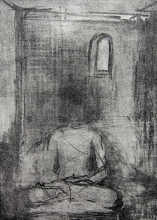
Annals of mechanization

On porcine reproduction and other automated practices in pork farming from Harpers. Note: Meat lovers are instructed to proceed with caution if one plans on reading the full report.

The boars were as big and as furry as bears. Each had its own pen—but in the last stall, in place of a pig, was what looked like a blue plastic saddle standing a few feet off the ground. Watje opened this gate and led a white boar into the corral.
“I’ve been training this one,” Watje said. “We’ll see how he does.”
The boar walked straight to the dummy and mounted without hesitation. Now, to be fair, this is a position few mammals are able to maintain with grace. But this boar, no doubt due to his lack of experience, made the pose look particularly awkward. One foreleg bent under his body. His back arched and his head lolled on the saddle.
Watje reached under the pig’s belly with one latex-gloved hand and squeezed a stream of clear liquid onto the ground.
“You want to get all the urine out of there,” he said. “Then you just hold on to the penis, which can be difficult because it’s slimy.”
He saw the look on my face and laughed. “Sometimes it’s so slippery I have to take the glove off to hold on.”
The tip of a boar’s penis is shaped like a corkscrew, which gives the semen harvester something to grip. The hog doesn’t need friction, just pressure.
The boar, meanwhile, was shifting, working his way around the dummy. Perhaps he had realized that things were not quite going according to plan and had hit on the idea that he had picked the wrong side. Watje rolled his eyes and hung on. When the moment came, he signaled me and I handed him the cup—an insulated coffee mug lined with a plastic bag and covered in cheesecloth. Watje pulled the penis—two feet long and pencil-thin—to the cup’s mouth and held it for three long minutes as the boar ejaculated. Then Watje took the cup inside. It held about half a pint.
“Usually I’d dilute it, but I’m out of distilled water,” he said, breaking what had become an uncomfortable silence.
“Do you ever stop in the middle of that and think, ‘I’m holding a boar’s penis’?” I blurted.
Watje laughed. “Sometimes my friends give me a hard time about it. But no, I’ve been doing this since I was a kid.”
He poured some of the liquid into a squeeze bottle and affixed the bottle to a long straw with a sponge on the end. The remaining semen went in a refrigerator—he sends it overnight to buyers at fifty dollars a dose. Depending on the boar, each ejaculate contains enough sperm to fertilize between ten and forty sows.
The sow was easy. Housed close to the boars, she needed no foreplay, none of the haunch and belly rubbing that Becky had described. Watje just sat on her back, facing her tail, and slid the semen straw inside. The sow leaned her heavy head against my shin while he slowly squeezed the bottle empty. Then it was over.

Close up of a Leon Kossoff painting from his recent exhibition at Mitchell-Innes & Nash gallery

Prediction corner

Extrapolations from sub-Saharan population growth numbers and other Malthusian predictions...

One striking implication of Africa’s population growth is that there will be a great religious revolution, as Africa becomes the home of monotheism. By midcentury, sub-Saharan Africa is likely to be the demographic center of Islam, home to as many Muslims as Asia and to far more than inhabit the Middle East. The non- Arab Muslim countries of Africa— Niger, Mali, Burkina Faso, and Senegal—constitute the one region of the Islamic world where birthrates remain high. In several of these countries, the average woman will have upward of five children in her lifetime.
Christianity will also feel the effects of Africa’s growth. By 2025, there will be as many Christians in sub- Saharan Africa— some 640 million— as in South America. By 2050, it is almost certain that most of the world’s Christians will live in Africa. As Kenyan scholar John Mbiti writes, “The centers of the church’s universality [are] no longer in Geneva, Rome, Athens, Paris, London, New York, but Kinshasa, Buenos Aires, Addis Ababa, and Manila.”
...By 2050, the national populations are expected to more than double in the Democratic Republic of the Congo and Uganda, reaching 147 million and 91 million, respectively. Smaller countries— such as Liberia, Niger, Mali, Chad, and Burundi—are expected to experience growth of 100 to 200 percent. These are the countries with the weakest state institutions, the least infrastructure, the feeblest economies, and thus the poorest health and education systems. They also face daunting problems of environmental degradation—and the lesson from Darfur and the Rwanda genocide is that disaster can follow when population growth strains local environments so badly that people cannot feed themselves.
... There is another development that could affect future Indian and Chinese birthrates: the use of sonograms to ascertain the sex of a fetus. Wider availability of this technology has permitted an increase in gender- specific abortions. The official Chinese figures suggest that 118 boys are now being born in China for every 100 girls. As a result, millions of Chinese males may never find a mate with whom to raise a conventional family. The Chinese call such lonely males “bare branches.”


Photographs from a recent visit to see DustinYellin's layered resin drawings at the Robert Miller Gallery

An Obama flip flop (a subtle one)

Last week Senators (Democrats joined Republicans) and blocked a vote on an amendment that would have allowed bankruptcy judges to modify troubled mortgages for ailing homeowners. Obama as a candidate was for it. Obama as President does not seem to for it... (or at least that is what might be read from the deafening silence emanating from the White House after the amendment failed). Now the plan is to keep Americans with mortgage issues in their homes relying on lenders (read: vultures) to voluntarily rework bad loans. Yeah, right!!

From here: Even if lenders do agree to modify loans, many Americans will still be in trouble. That’s because nearly 14 million homeowners are “under water” — they owe more on their mortgages than their homes are worth. In a bankruptcy, such homeowners would likely have their loan principal reduced, lowering their payments and helping them to rebuild equity. In a typical voluntary loan modification, however, the monthly payment is reduced, but not the principal. That puts under-water borrowers at high risk of redefault, because there is no equity to fall back on if a financial setback leaves them unable to make mortgage payments. The negative feedback loop — foreclosures beget falling home prices, which beget foreclosures, further weakening the banks — is well under way.
Apartment in Chelsea

Trends

As more of us live more of our lives in digital contexts, it seems plausible that immaterialism will become more common. Consuming things made of bits might sound weird, but actually it offers a lot of the same attractions that make people consume things made of atoms. Facebook’s digital gifting is one relatively mainstream example. Consider the Fort Worth, Tex., company Alamofire. Its best-known creation is a Facebook application called Pack Rat. While nominally a game, it’s really premised on a virtual version of the urge to collect things: in this case, the things are “cards” that are basically little pixel-pictures. The company calls its wares “digital collectibles.”
Josh Williams, a founder of Alamofire, figured out the appeal of collecting pixelated stuff by accident. Originally he was in the business of designing digital icons, and he and his partners decided to make some of their creations available for others to use, free. There were thousands of takers, and he got curious about what they were doing with the icons. The most prominent answer turned out to be: Nothing much, just collecting them, trading them, using them as means of fun social connection with other collectors. “A light bulb went off,” Williams says. “We were in the wrong business.” Alamofire’s new project is called Gowalla. This time, the product is more tied to mobile devices like the iPhone and involves “collecting” digital icons by (nondigitally) visiting certain spots in various cities. Really, he figures, it’s not so different from what inspired earlier generations to collect postcards or other gewgaws. But, Williams adds, without “all the physical crap.”
Photo from the exhibition 'Collage Geomancy' by Michael Anderson at the Marlborough Chelsea

Sunday, May 03, 2009

On the Appalachian Trail - 2

All pictures along the Appalachian Trail from the NJ PA terminus to Sunfish Pond.


As piecemeal explorations of the Appalachian Trail (AT) in NJ continue, here are some notes from the hike for future reference. This time, we (my wife and I) decided to explore the northbound AT from the NJ/PA state border (near the Delaware Water Gap National Recreation Area) leading to Sunfish Pond – a trek of about 3.7 miles and climb of about 1380 feet (a good map here). Most of the trail goes through the Worthington State Forest (a parcel of about 6000 acres of wooded forest that the state of NJ bought from the Worthington family in 1954). 
Car parking is relatively easy: Proceed on Interstate 80 westbound about 3 miles past Exits 4A/B/C, stay in the right lane and take the rest area exit on the right. Continue on the service road down past the rest area, and up an entrance ramp as if to re-enter Interstate 80 westbound. Turn right from the ramp before it re-enters Interstate 80 into Dunnfield Parking Area. Remember to enter the second parking lot. The first lot leads to the Tammany trail to Mount Tammany (a 1250 ft. climb). The second lot directly leads to the Appalachian Trail. 
The Dunnfield creek running parallel to the AT for the first 20 minutes of the trek and it presents waterfalls, a steel bridge, great views and sounds of falling water. The creek is said to contain trout and there is a limit of two per angler for those with fishing aspirations. The deepest point seems to be 8 feet and swimming is allowed. The early morning spring air was fresh and crackled with the sounds of many birds whose names we did not really know but would have loved to find out. About 40% of the trek involves lots of ‘heads down’ hiking because of the profusion of small to medium sized rocks and stones that have been used to pave the AT. In some cases, the trail volunteers cleverly used natural rock formations that wind up and down in exquisite ways to build the trail. Most of the climbing is aided along by wooden steps built of timber and locked in place onto the trail with spikes and mini piles. Most of the climbing levels out by the time one reaches the red-blazed Holy Springs Trail crossing the AT. Holy Springs Trail lies roughly in the middle between the parking lot and the Sunfish Pond. An hour after the Holly Springs Trail and more moderate climbing, one comes across Backpacker Site 2 (for those considering camping, this might be the best place to camp for ‘through hikers’ as camping is not permitted along any other areas of the Worthington State Forest). The campsite is located just across the blue-blazed Douglas Trail which heads off to the left from the AT (for northbound hikers). The views are not too exciting, but one manages glimpses of the heavily wooded ridge of the 1500 foot Mount Tammany every once in a while to the right. The hike from Douglas Trail to Sunfish pond involves a little more climbing (no sharp gradients). 
Sunfish pond is a 41 acre glacial pond leftover from the last ice age. According to the National Park Service, the lake is one of fourteen rock-basin lakes between the Delaware Water Gap and the Kittatinny Ridge. Camping is not allowed near the lake. The views are stunning as one follows the AT along the western shore of the lake with multiple lookout points to sit, relax and enjoy water views. We ran into a grey haired couple who were celebrating their 35th wedding anniversary by climbing up to the lake using the Garvey Spring Trail. During conversations, they reminisced that their home was a madhouse until their four children left and now it seems as quiet as a library. The lady mentioned that she misses the children while her husband told us that he prefers the ‘library’ phase. Interesting how we are genetically programmed. We told them that we have two boys and we were preparing for the ‘madhouse’ phase. It is a great feeling when one runs into committed families living together for 35 years without running into the usual visitations of divorce, remarriage, step relatives and the associated angst. We had lunch by the edge of the pond (store baked turkey, pepperjack cheese slices on wheat bread and blue colored mountain berry flavored Powerade). A sign near the lake said that the lake has pumpkinseed sunfish and yellow perch. The sign also said that the lake is acidic in nature and not many other species of fish survive in the water. Watch out for snakes. We counted at least three snakes along the pond. One of them – a black scaled snake (probably a northern black racer snake) about four feet long – was sunning itself along a floating branch that had fallen into the water and did not seem to care for us too much. There is a monument erected by the US Department of the Interior in 1970 that designates the lake as a registered natural landmark. We wondered what happens after one of these designations… We are guessing not too much, but one could be wrong. 
We retraced our steps back to the parking lot after spending about an hour by the lake. We said hello to an old lady, her son and a shaggy Labrador who had decided to take a bath in Dunnfield Creek near the base of the trail. This section of the trail is popular amongst a wide range of adventure seekers ranging from the wiry health nuts who seem to race up the trail to families who seem to be leisurely strolling along as if for a weekend walk. An interesting encounter involved us running into a couple of South Asian youth who seemed to a little lost on the trail (one of them was even sporting a maroon evening jacket and looked like he was headed out to a restaurant – a most incongruous sight indeed). They were about fifteen minutes from the parking lot and we told them that Sunfish pond was a couple of hours upfront. They balked at the amount they had to climb to reach a place where (in their words) they could ‘stretch out and relax’ and seemed to promptly head back. 

Part I here. 

Friday, May 01, 2009

Photo

Corridor inside the New York Public Library

Wednesday, April 29, 2009

Dialogue

Jon Stewart's extended interview with Cliff May on torture... A very intense but important dialogue...

See the whole unedited version here...

Leecher chronicles

Google's book scanning/search project is running into troubled waters. Much as I would like all books and their text neatly accessible and seachable under a clean, spare interface, issues linger...

From here: Google’s entire business model is the commoditization of other people’s content. See Google News, Gmail, AdSense/Adwords, etc. Book Search puts Google in the driver’s seat of determining how online books are monetized, at what rates, what share Google, authors and publishers get, how the metrics are determined. Books are reduced to data. Competitors are cut out. Other players remain unable to use the orphan works. Google leverages the audience. Newspapers will die because they have been commoditized out of existence (with some fatal mistakes of their own along the way.) Do we really want books to go the same way?

Ideas on gun control

New York's own reformed john, Eliot Spitzer poses a good question and explores how we could use government procurement regulations to limit gun violence...

Those of us who were in law enforcement in New York City in the late '80s and early '90s remember how drug dealers pioneered the use of 9-mm guns. We heard over and over from our friends in the police department that they were outgunned, that their service revolvers were no match for semi-automatics in a shootout. So what did the police do? The New York City Police Department finally bought 9-mms, too. It was a classic arms race, with the gun manufacturers in the economically enviable position of selling bigger and better guns to both sides. This prompts a simple question: Why do we buy guns from companies that permit their products to be sold to bad guys?

Recent pictures


Stephen A. Schwarzman Building, 5th and 42nd, New York City, NY

Syllabus

McSweeneys has a very helpful internet age writing syllabus and course overview here:  

ENG 371WR: Writing for Nonreaders in the Postprint Era; M-W-F: 11:00 a.m. – 12:15 p.m. Instructor: Robert Lanham
Prerequisites: Students must have completed at least two of the following.
ENG: 232WR — Advanced Tweeting: The Elements of Droll
LIT: 223 — Early-21st-Century Literature: 140 Characters or Less
ENG: 102 — Staring Blankly at Handheld Devices While Others Are Talking
ENG: 301 — Advanced Blog and Book Skimming
ENG: 231WR — Facebook Wall Alliteration and Assonance
LIT: 202 — The Literary Merits of Lolcats
LIT: 209 — Internet-Age Surrealistic Narcissism and Self-Absorption
Thanks to Bookslut for the link.

Wednesday Poem

Someone 
is looking at some horrible photo realistic paintings 
wonders if the R's will come to D's funeral since they didn't come to S's
is crying for love.
is glad to be kidnapped by Francesca on a beautiful Saturday 
is fucking bored at work
has visions of swastikas inside their heads
thinks that in the end everyone ends up alone.
hates two words: accounting software. God help us
says boys and girls should make love 
found this guitar for $25 at the Goodwill in Pittsburgh
is visiting the detox center tonight 
is opening all the windows and letting the breeze and the sun in 
is doing naughty aerobics with Mexicans in Cabo!
is too busy to be at work today but is there anyways
is planting peas and carrots and pansies
is making sake for tonight
thinks that the downturn has not been bad
is building a bridge to nowhere with her
vehemently insisted that jokes about the holocaust are bad
lost imaginary wealth and real weight recently
likes H's peaches and would like to shake your tree.
is at the beach w/ my blondieee!
is sad that seeqpod is dead
is at work while everyone is at the beach... blah!
says what is up with everyone breaking up.... its time for lovin
thinks someday.. somebody will....
stumbled into town, just like a sacred cow
gives a big Bangalore hug to all friends back in NYC and beyond
is tired of waitin 4 the resultz. It's tougher than preparin 4 it!
had a good hair and boiled brain day....
says sorry to women he had wronged
thinks hope floats but sinks like a stone in winter
is so enjoying the dancing! Tuesday is audition day
wonders why go through the process when you have a short cut
thinks why make love when you can get it
really really likes not working, wants a hot dog and is a Pheonix
thinks that it's our heart that makes us more than what we are
was shocked out of her brains last night!!!! 
won't tell a soul what she saw or how big it was
was happy that Adam Gopnik hugged her 
is watching the dog chew on a bone while Rush lashes out
thinks he spends more hours of the day drunk than sober
just picked up some of the last walnuts and set them to dry
is knackered, slathered and needs a nanny-nap
says that what doesn't kill a quail only makes it stronger.
is contemplating what chore to put off doing.
is a whore with a chore
thinks of the time when a fish swam into a wall and said "damn!"
just arrived home from the hospice after losing a very good friend
is recuperating from an Irish night out
needs and wants to give H a good bad spanking
knew a banker who killed a homeowner (albeit indirectly)
wore leotards under her pants to work
saw a Hummer hit a cyclist sending the poor bloke to the ER 
did something hot and sweaty and it was not what you think
thinks they should have aspirin bars - to chew on the night after
is missing the good times, but remains chaste
says don’t get cute or clever, just go with your gut 
did it in a few minutes
got the job woot woot!!!!! yayyy!
is protesting in front of the turkish embassy today
says shush girl, shut your lips; do a Helen Keller, talk with your hips
believes in equality for all, except reporters and photographers
has home cleaning work all day then performance at club españa
is thinking perhaps he'll have the Molson's for lunch
just noticed that his neighbor's kitchen was torn down. Foreclosure?
is hereby waiting for a spaceship to take him away

Note: This is the second of what I might call 'Facebook' based poems - made up entirely of people's status updates. The first one can be found here... 

Tuesday, April 28, 2009

Face

A Tamil woman holds a malnourished child at a makeshift hospital inside the war zone in Putumattalan, Sri Lanka. The photo was taken earlier this month. Image from Bigpicture. 

It should be borne in mind that civilians like these are being used as human shields by the LTTE (Liberation Tigers of Tamil Eelam) against the advancing Sri Lankan army forces. The LTTE, a terrorist organization bent on carving a Tamil state inside Sri Lanka was one of the first organizations to systematically use suicide bombings in terrorizing people. I still vividly remember the loss after Rajiv Gandhi was blown up by Thenmozhi Rajaratnam, a female terrorist of the Liberation Tigers of Tamil Eelam. 

Splitsville soliloquy

Hendrik Hertzberg of the New Yorker expands on the scenario involving erstwhile 'Confederate States' following Governor Rick Perry’s low IQ suggestion that Texas might end its association with the United States of America and strike out on its own.

The border between the United States and the Federated States (“Confederate” being a word that remains a little too provocative) might not be as trouble-free as that between the United States and Canada, but, compared to the border with Mexico, it would probably require somewhat fewer armed citizen militias and fences topped with concertina wire to thwart illegal aliens desperate for a better life. On balance, trade relations between the U.S. and the F.S. would be advantageous to both. Cultural exchanges, tourism, and even a degree of military cooperation would be far from unthinkable.For the old country, the benefits would be obvious. A more intimately sized Congress would briskly enact sensible gun control, universal health insurance, and ample support for the arts, the humanities, and the sciences. Although Texas itself has been a net contributor to the Treasury—it gets back ninety-four cents for each dollar it sends to Washington—nearly all the other potential F.S. states, especially the ones whose politicians complain most loudly about the federal jackboot, are on the dole. (South Carolina, for example, receives $1.35 on the dollar, as compared with Illinois’s seventy-five cents.) Republicans would have a hard time winning elections for a generation or two, but eventually a responsible opposition party would emerge, along the lines of Britain’s Conservatives, and a normal alternation in power could return. The Federated States, meanwhile, could get on with the business of protecting the sanctity of marriage, mandating organized prayer sessions and the teaching of creationism in schools, and giving the theory that eliminating taxes increases government revenues a fair test. Although Texas and the other likely F.S. states already conduct some eighty-six per cent of executions, their death rows remain clogged with thousands of prisoners kept alive by meddling judges. These would be rapidly cleared out, providing more prison space for abortion providers. Although there might be some economic dislocation at first, the F.S. could remedy this by taking advantage of its eligibility for OPEC membership and arranging a new “oil shock.” Failing that, foreign aid could be solicited from Washington. But the greatest benefit would be psychological: freed from the condescension of metropolitan elites and Hollywood degenerates, the new country could tap its dormant creativity and develop a truly distinctive Way of Life.
Emperor Dom Pedro II of Brazil had invited the Confederados to his nation. Image from the The Imperial Museum of Brazil.

A culture of optimism?

As Specter shifts loyalties...

From here: The broader symbolism here is that it’s another sign that Barack Obama’s first two years may not look like Bill Clinton’s. In 1993-94, Clinton’s approval ratings sagged, his party lost special elections everywhere, and conservative Democrats were switching to the GOP. Obama’s approval ratings are high and holding steady, Democrats remain far more popular than Republicans, Democrats held the first special election, and now they’ve picked up a party switch. It’s still early, but Obama is starting to build a self-sustaining psychology of success.

Sunday, April 26, 2009

Face

Rekha Kalindi, a 12-year-old girl living in Bararola, India,refused to get married when her parents tried to arrange one she wanted to stay in school. Her revolt, and those of two other girls in the region, have halted new child marriages in their rural region of West Bengal, India. The legal age for marriage in India is 18 for girls and 21 for boys. But arecent study published in the Lancet found 44.5 percent of Indian women in their early 20s had been wed by the time they were 18. Of those, 22.6 percent had been married before age 16, 2.6 percent before age 13.

More here.

Saturday, April 25, 2009

Pragmatic decision-making department

The new buyers of art are a little more circumspect...

Gone are the new rich — the Russian oligarchs and oil-rich Middle Easterners, as well as the American hedge fund magnates — who in flush times were willing to pay any price. Gone too are the Europeans who were active when the weak dollar made their purchases seem cheap. Today’s buyers tend to be older collectors who bowed out of the market when prices began escalating several years ago. These patrons have far more conservative tastes, preferring works by tried-and-true names like Alexander Calder or Robert Ryman rather than those by younger artists like Takashi Murakami or Damien Hirst who were snapped up by speculators and have now lost some 50 percent of their value.
What is selling, said Brett Gorvy, a co-head of Christie’s postwar and contemporary-art department, is “the right artist and the right work.”

Worth noting about the torture brouhaha

From here.
We’ve learned much, much more about America and torture in the past five years. But as Mark Danner recently wrote, for all the revelations, one essential fact remains unchanged: “By no later than the summer of 2004, the American people had before them the basic narrative of how the elected and appointed officials of their government decided to torture prisoners and how they went about it.” When the Obama administration said it declassified  four new torture memos 10 days ago in part because their contents were already largely public, it was right.

Photo


Early morning. Wall, NJ

Late evening. Wall NJ

Friday, April 24, 2009

Questions, Questions...

Salf flagellation is undesirable, but the rule of law is the most important thing that makes the United States the United States. That is why people still stand in line to come here.  

From Andrew Sullivan's blog. 

Toot Toot!

'Buy Me Bring Me Take Me', an oil on canvas completed a couple of years back was selected to be the masthead for UGallery.com as they get ready for the Affordable Art Fair 09' starting next month in NYC. 

History break

A screen shot from the pages of the New York Times this day 100 years back.


Roughly 1.2 million Armenians would either be slaughtered by Turkish killing squads or would die of exposure or starve to death in camps in the deserts at the southeastern edges of the Ottoman Empire. The Armenian genocide was the culmination of a decades long process of persecution of the Armenians in the Ottoman empire. That persecution was punctuated in the last two decades of the 19th century during the reign of Sultan Abdul Hamit, the so-called Red Sultan.
Frontpage magazine published an interview with Vahakn Dadrian, a scholar of the Armenian genocide about five years back. It is still worth reading for the historical perspectives offered. Note: The tone is fairly partisan.

From the interview: Islam played a major role both in the period of the Abdul Hamit massacres [1894-1896] and the 1909 Adana massacres and the World War I genocide. During the Abdul Hamit era, Islam was the main impetus, the direct impetus of the massacres, because 90 percent of the massacres took place on Fridays, which is the religious holiday. Immediately at the end of the religious ceremonies in the mosques, the mobs, harangued by Muslim clerics, were incited and as a result the motivation was reinforced to attack and massacre the Armenian population of the respective regions. In other words, Islam as an institution, and champions of Islam, the Muslim clerics, played a major role in the organization and execution of the series of massacres. In World War I, Islam also was exploited by way of formally declaring jihad, the main target of which became the Christian Armenians. Holy War can only be proclaimed by the sultan who is also the Khalif, the supreme religious authority, and the Sheikh ul Islam, the religious head of Islam. One of the greatest incentives of jihad for motivating people to kill is the promise of celestial bliss, and other kinds of rewards in heaven. This played a major role in mobilizing the masses, the naïve masses. In Archbishop Balakian's book, the Armenian Golgotha, there are scenes in which, after every massacre, the head of the gendarmes units, spread his prayer rug and thanked god for serving him through jihad-borne massacres massacres.

Toon

More of Tim Goheen's works here.

Connections and reasons...

Today 60 people were killed by suicide bombers across Iraq. Yesterday the toll was higher. 80 people were killed. It is difficult to read this and not think about new revelations reported by McClatchy a couple of days back which asserted that the Bush administration applied relentless pressure on interrogators to use harsh methods on detainees in part to find evidence of cooperation between al Qaeda and the late Iraqi leader Saddam Hussein.

Such information would've provided a foundation for one of former President George W. Bush's main arguments for invading Iraq in 2003. In fact, no evidence has ever been found of operational ties between Osama bin Laden's terrorist network and Saddam's regime. The use of abusive interrogation — widely considered torture — as part of Bush's quest for a rationale to invade Iraq came to light as the Senate issued a major report tracing the origin of the abuses and President Barack Obama opened the door to prosecuting former U.S. officials for approving them."There were two reasons why these interrogations were so persistent, and why extreme methods were used," the former senior intelligence official said on condition of anonymity because of the issue's sensitivity. 
..."The main one is that everyone was worried about some kind of follow-up attack (after 9/11). But for most of 2002 and into 2003, Cheney and Rumsfeld, especially, were also demanding proof of the links between al Qaida and Iraq that (former Iraqi exile leader Ahmed) Chalabi and others had told them were there." It was during this period that CIA interrogators waterboarded two alleged top al Qaida detainees repeatedly — Abu Zubaydah at least 83 times in August 2002 and Khalid Sheik Muhammed 183 times in March 2003.

Relatives mourned in Dhuluiya, north of Baghdad at the funeral of an Iraqi who was among the 80 killed across the country yesterday. Photo from the Associated Press

Keith Olbermann analyzes the timelines involved in this and talks to Jonathan Landay, the McClatchy reporter who first revealed that torture was used to forcibly produce false testimony reflecting a connection between Iraq and al-Qaeda.

Art. Fail. Completely.

From yesterday's NY Times... an exercise in cheapskate, wannabe solutions to having art on one's walls. On the other hand, it begs the question - what is art?

From here: Juan Montoya created a piece of “art” by hanging a canvas he painted with Benjamin Moore’s Big Country Blue over an ample sofa. One visitor to the room asked if the painting was by Barnett Newman,” he said. Nobody knows it didn’t come from a gallery.” Mr. Montoya used a 6 by 12 foot canvas; a 24 by 48 inch canvas, sized to fit a less cavernous room, is about $36 at dickblick.com.

Thursday, April 23, 2009

From the Lone Star Looney bin - II

This time it is wackos from Waco, Texas who seem to believe that the Moon generates its own light and does not reflect light... 

The Emmy-winning scientist [Bill Nye] angered a few audience members when he criticized literal interpretation of the biblical verse Genesis 1:16, which reads: "God made two great lights - the greater light to govern the day and the lesser light to govern the night. He also made the stars." He pointed out that the sun, the "greater light," is but one of countless stars and that the "lesser light" is the moon, which really is not a light at all, rather a reflector of light. A number of audience members left the room at that point, visibly angered by what some perceived as irreverence. "We believe in a God!" exclaimed one woman as she left the room with three young children.