
Jon Stewart's extended interview with Cliff May on torture... A very intense but important dialogue...
See the whole unedited version here...
We’ve learned much, much more about America and torture in the past five years. But as Mark Danner recently wrote, for all the revelations, one essential fact remains unchanged: “By no later than the summer of 2004, the American people had before them the basic narrative of how the elected and appointed officials of their government decided to torture prisoners and how they went about it.” When the Obama administration said it declassified four new torture memos 10 days ago in part because their contents were already largely public, it was right.
Visit msnbc.com for Breaking News, World News, and News about the Economy
Such information would've provided a foundation for one of former President George W. Bush's main arguments for invading Iraq in 2003. In fact, no evidence has ever been found of operational ties between Osama bin Laden's terrorist network and Saddam's regime. The use of abusive interrogation — widely considered torture — as part of Bush's quest for a rationale to invade Iraq came to light as the Senate issued a major report tracing the origin of the abuses and President Barack Obama opened the door to prosecuting former U.S. officials for approving them."There were two reasons why these interrogations were so persistent, and why extreme methods were used," the former senior intelligence official said on condition of anonymity because of the issue's sensitivity...."The main one is that everyone was worried about some kind of follow-up attack (after 9/11). But for most of 2002 and into 2003, Cheney and Rumsfeld, especially, were also demanding proof of the links between al Qaida and Iraq that (former Iraqi exile leader Ahmed) Chalabi and others had told them were there." It was during this period that CIA interrogators waterboarded two alleged top al Qaida detainees repeatedly — Abu Zubaydah at least 83 times in August 2002 and Khalid Sheik Muhammed 183 times in March 2003.

Relatives mourned in Dhuluiya, north of Baghdad at the funeral of an Iraqi who was among the 80 killed across the country yesterday. Photo from the Associated Press
Visit msnbc.com for Breaking News, World News, and News about the Economy
When the Central Intelligence Agency obliterates a dozen suspected terrorists, along with assorted family members, with a missile from a drone, the news rarely stirs a strong reaction far beyond Pakistan. Yet the waterboarding of three operatives from Al Qaeda — one of them the admitted murderer of 3,000 people as organizer of the 9/11 attacks — has stirred years of recriminations, calls for prosecution and national soul-searching.
 Photo from the works of Lisa Ross at Daneyal Mahmood Gallery titled 'Unrevealed'. From the press release: Lisa Ross’s work concerns itself mainly with memory, temporality and the visual expression of faith. It is on the embodiment of the secular and the sacred that this work relies; a reconceptualization of the corporeal and its interdependence with time and place. Picture above shows 'Black Garden (crib with door)', 2002 - 2008, oil pigment on rag paper.
With the facial slap or insult slap, the interrogator slaps the individuals face with fingers slightly spread. The hand makes contact with the area directly between the tip of the individuals chin and bottom of the corresponding earlobe. The interrogator invades the individuals personal space....Cramped confinement involves the placement of the individual in a confined space, the dimensions of which restrict the individuals movement. The confined space is usually dark. The duration of confinement varies based upon the size of the container. For the larger confined space, the individual can stand up or sit down; the smaller space is large enough for the subject to sit down.... Wall standing is used to induce muscle fatigue. The individual stands about four to five feet from a wall, with his feet spread approximately to shoulder width. His arms are stretched out in front of him, with his fingers resting on the wall.... Finally, you would like to use a technique called the 'waterboard'. In this procedure, the individual is bound securely to an inclined bench, which is approximately four feet by seven feet. The individuals feet are generally elevated. A cloth is placed over the forehead and eyes. Water is then applied to the cloth in a controlled manner. As this is done, the cloth is lowered until it covers both the nose and mouth. Once the cloth is saturated and completely covers the mouth and nose, air flow is restricted for 20 to 40 seconds due to the presence of the cloth. This causes an increase in carbon dioxide level in the individuals blood. This increase in the carbon dioxide level stimulates increased effort to breathe. This effort plus the cloth produces the perception of "suffocation and incipient panic" i.e. the perception of drowning. The individual does not breathe any water into his lungs. During those 20 to 40 seconds, water is continuously applied from a height of twelve to twenty-four inches. After this period, the cloth is lifted, and the individual is allowed to breathe unimpeded for three to four full breathes. The sensation of drowning is immediately relieved by the removal of the cloth. The procedure may then be repeated. The water is usually applied from a canteen cup or small watering can with a spout.
Over the course of this renaissance in interrogation tactics, our attitudes changed. We no longer saw our prisoners as the stereotypical al-Qaeda evildoers we had been repeatedly briefed to expect; we saw them as Sunni Iraqis, often family men protecting themselves from Shiite militias and trying to ensure that their fellow Sunnis would still have some access to wealth and power in the new Iraq. Most surprisingly, they turned out to despise al-Qaeda in Iraq as much as they despised us, but Zarqawi and his thugs were willing to provide them with arms and money. We're told that our only options are to persist in carrying out torture or to face another terrorist attack. But there truly is a better way to carry out interrogations -- and a way to get out of this false choice between torture and terror.
My experiences have landed me in the middle of another war -- one even more important than the Iraq conflict. The war after the war is a fight about who we are as Americans. Murderers like Zarqawi can kill us, but they can't force us to change who we are. We can only do that to ourselves. One day, when my grandkids sit on my knee and ask me about the war, I'll say to them, "Which one?"
I have said repeatedly that I intend to close Guantanamo, and I will follow through on that. I have said repeatedly that America doesn’t torture, and I’m going to make sure that we don’t torture.After being a helpless observer for the last eight years and in particular, after watching the systematic excision of liberties as depicted in the movie ‘Torturing Democracy’, I must say that it is a sign of change when the only person who has the power to close Guantanamo actually makes a statement that he is going to do so.
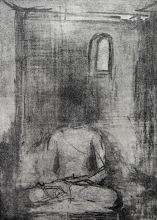
 Sunil, 'Black(water)boarding', Charcoal and pencil on paper, 12" X 9"


