Sunday, July 15, 2007

Palimpsest(ic) deviation

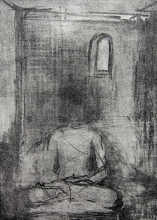
Palimpsest; Housepaint on MDF; 48" X 48"

Sometimes you work on a painting for a month and it does not turn out the way it is supposed to. Recently I had an opportunity to experience this sinking emotion. I usually destroy work that I do not like, but this time I could not really fold up the canvas and throw it away as the painting was done on gessoed MDF (and a large one at that - 48" X 48").
I decided to throw a little bit of abstraction on top of the painting that I did not like. This way, I could escape from dumping a large block of MDF on the street and have a bit of fun splashing house paint all over it. The above picture was the result. The funny thing with house paint is that it settles and coalesces a bit on drying. Will be interesting to see this in a weeks time after all the coalescing and blotting is complete... I named it after reading Tree's post on roadways as a palimpsest(ic) surface.

Friday, July 13, 2007

Poetry

Thomas Moran (1837-1926), ‘Moonlight, Icebergs in Mid Atlantic’, 1910, Oil on unlined canvas, 20 X 30 inches, Private collection.


In late April of 1890 on a trip to Venice, Moran's ship was en route to Antwerp when it passed an iceberg. He made a rapid pencil drawing and as he could not sketch quickly enough, he described verbally: 'water pouring over the sides of the berg, deep blue water and rollers capped with foam'. This was painted about twenty years after his sighting of the icebergs in the middle of the Atlantic.

Thomas Moran was an extremely famous landscape painter and this one was one of his lesser known 'sea' paintings... This painting is a riot of clouds, waves, floating ice mountains with the ice resembling rocks and vice versa. By confusing the distinctions of a foamy head of a wave with the sharp edges of ice, Moran artfully engages us in deception of visual detail that can be so reminiscent of an open raging sea.

A gallery visit that made me think

Marina Abramovic; Role Exchange; 1975; published in 1994; 2 black and white photographs with 1 letter press text panel. 3 AP's framed: 29 3/4 x 39 1/2 inches; framed text:10 1/4 x 7 1/4


Themed sims or simulations around a particular theme abound in Second Life at this point in time. They combine elements of art and roleplay. The participant will need to enter an environment where the participant will play the role of the character s(he) dons and then interact with the themed situation in an appropriate manner. I have not been into one, but I hear that they are a lot of fun.

Role playing has been around/functional since time immemorial. I am sure this was a evolutionary trait refined and developed to ensure that the right functional aspects of a personality are utilized efficiently at the right times to ensure our survival as a social species. Sometimes we don the roles unconsciously and sometimes of our own volition. While the former may be part of the everyday life we lead (roles such as mother, father, manager, husband, wife etc), the latter is indulged for the purposes of make-believe by people who would like to indulge and live out in their own private fantasies.

Artists, given their creative nature have experimented a lot with roleplay. Marcel Duchamp explored the possibilities with Rrose Sélavy in 1921. It was with a lot of hopes and expectation that I approached the exhibition at Sean Kelly yesterday to look at some of these artistic explorations (the exhibition winds down on August 03). Fortunately, I was not disappointed in the least. In fact I came away from the show thoroughly stimulated and made it a point to tell the gallery managers on the selection and groupings of the works included in this excellent exhibition.

Themed around a point in time when the performance artist Marina Abramovic (see above) exchanges her artist roles with a prostitute in Amsterdam in the mid 70's, the show does not disappoint. Abramovic strutted her wares at the prostitute’s booth for four hours while the real prostitute went to an opening reception of the real artist. The idea is both revelatory and exploratory.

Most of the pieces in this show are of a similar nature where artists are trying to explore the issues of identity and self through assuming other roles and genders (in some cases fictional identities). Among the greatest hits at this exhibition that I wholeheartedly urge you to attend are pictured below (the pictures have been ripped from the gallery website or from public websites):

The pictures below are but a minor selection from the 27 artists on display there. A fascinating exploration that will leave you thinking a little more deeply into the roles we play (and do not / ought not) over the courses of our everyday lives.

My only wish was they had included some paintings, but I am not complaining.


Douglas Gordon; Staying Out and Going Home; 2005; two Polaroid photographsframed: 8 1/2 x 14 1/2 inches (21.6 x 36.8 cm)


Yinka Shinibare; Dorian Gray; 2001; 11 black and white resin prints, 1 digital lambda print; each print: 30 x 37 1/2 inches, overall: 130 x 175 inches


Andy Warhol; Self Portrait in Drag; 1981; Polaroid photograph


Samuel Fosso; The liberated american woman of the 70's; 1997C-print on Aluminum; Framed 51 X 51 inches


Douglas Gordon; Monster in the Making; 1995; 6 minute color video


Gavin Turk; Bum; 1998; Wax mixed with resin and polyester; 65 X 27 X 27 inches

Thursday, July 12, 2007

Post over at Art and Perception

I have a post over at Art and Perception on self portraits. It will be interesting to see the resulting discussion...


Otto Dix: "By reproducing the external form, one captures the inner gestalt". "Self-portraits are confessions of an inner state, they always come as a surprise to me. I look at them and think, why, that's not what you look like at all. There is no objectivity there; only ceaseless transformation; a human being has so many facets. The self-portrait is the best means of studying them"

Francis Bacon: "I had no idea what to do next, so I thought, 'why not paint myself?"

Susan Sontag: "The self is a project, something to be built"

Wednesday, July 11, 2007

Workers, unions and web servers

I have often wondered about job stability stories from our parents when all they had to do to have a secure jobs was to be a member of a union at work. As soon as you were a member of the union, you were assured that you could not be fired, health care benefits were superb and life in general was good. Today that seems to have gone by the wayside. Unions are struggling with dwindling memberships and membership in a union at work means nothing. A recent essay by Paul Graham (his social thoughts are pretty good for a hard core technologist - you should read his other essay on good/bad art) brings out an interesting viewpoint on why the power of the unions may be dwindling.
The Builders, 1950 by Fernand Leger

Oddly enough, it was working with startups that made me realize where the high-paying union job came from. In a rapidly growing market, you don't worry too much about efficiency. It's more important to grow fast. If there's some mundane problem getting in your way, and there's a simple solution that's somewhat expensive, just take it and get on with more important things. EBay didn't win by paying less for servers than their competitors.

Difficult though it may be to imagine now, manufacturing was a growth industry in the mid twentieth century. This was an era when small firms making everything from cars to candy were getting consolidated into a new kind of corporation with national reach and huge economies of scale. You had to grow fast or die. Workers were for these companies what servers are for an Internet startup. A reliable supply was more important than low cost.

If you looked in the head of a 1950s auto executive, the attitude must have been: sure, give 'em whatever they ask for, so long as the new model isn't delayed. In other words, those workers were not paid what their work was worth. Circumstances being what they were, companies would have been stupid to insist on paying them so little.

The early twentieth century was just a fast-growing startup overpaying for infrastructure. And we in the present are not a fallen people, who have abandoned whatever mysterious high-minded principles produced the high-paying union job. We simply live in a time when the fast-growing companies overspend on different things.


Fernand Leger, Construction Workers

It is an interesting world we live in when yesterday assets i.e. 'people' are compared to today’s assets 'web servers'. Looks like companies lavished the same amount of attention on these two resources at appropriate times in history. What will it be tomorrow? Transformers?

Percentage spending of disposable income on art...


An article typical of the Wall Street Journal (profiling the lives of the rich) contained the following chart that was instructive of the spending patterns of rich folks around the world. It is interesting to note that people in Europe and Latin America tend to spend higher on art purchases (as percentages of their disposable incomes) that the rest of the world. For some reason I thought it would be the Americas and Europe.

Tuesday, July 10, 2007

Hands

by Jean Sprackland

She peels cod fillets off the slab,
dips them in batter, drops them
one by one into the storm of hot fat.
I watch her scrubbed hands,
elegant at the work,

and think of the hands of the midwife
stroking wet hair from my face as I sobbed and cursed,
calling me sweetheart and wheeling in more gas,
hauling out at last my slippery fish of a son.
He was all silence and milky blue. She took him away
and brought him back breathing,
wrapped in a white sheet. By then
I loved her like my own mother.

I stand here speechless in the steam and banter,
as she makes hospital corners of my hot paper parcel.

Leonardo da Vinci, 'Study of hands', circa 1474, Silverpoint and white highlights on pink prepared paper, 214 x 150 mm, Royal Library, Windsor

Musings on South India...

Come next month and it will be 10 years since I left India. Before that, I lived all my life in the South Indian city of Bangalore. Every once in a while I read news about the burgeoning economy of the Asian tigers and BRIC's and about parents here confused on whether their children should learn Chinese, Hindi or Russian as opposed to Spanish as a second language.
Internecine parlays between groups of people that constitute nations are common and such is the case with India also. In this vein, I could not resist posting this link from Outlook India magazine that looks to the growth of South Indians and how they are regarded by the rest of India as opposed to say 20 years back (both of which I remember only too well and am able to compare).


General:
The typical North Indian regarded the typical South Indian as short, squat, black, effete—and vegetarian. But now, those once proud people are voting with their feet to move south. Now, the stereotype of the South Indian among Punjabis and Biharis is that he is intelligent, hardworking, entrepreneurial, and open-minded. And that he can very often be a she. And, most importantly, that if you study well and behave yourself, she or he can give you a job.


Raja Ravi Varma (1848 - 1906), 'The Orchestra', Oil on canvas, Sri Jayachamarajendra Art Gallery, Mysore


Outlook

One striking difference between north and south India relates to how they have viewed people from far away. The foreigner came to the north as a marauder and conqueror; to the south, as a traveler and trader. This is as truer of 'foreign' religions as it is of foreign individuals. There were Christians in Kerala several centuries before there were Christians in Europe. Unlike their northern counterparts, the Moplah Muslims of Malabar speak Malayalam, not Urdu—besides, no one can accuse them of identification with invaders or interlopers.

That the residents of the four southern states are, on the whole, less bigoted and more forward-looking is a product not of their genes but of their environment. Over hundreds of years, they have learnt to live with people speaking different tongues or professing a different faith. At the same time, they have also learnt to be less discriminatory among themselves.


Raja Ravi Varma (1848 - 1906), 'Portrait of a North Indian Lady', Oil on canvas, Sri Jayachamarajendra Art Gallery, Mysore

Women
Women in the south are less likely to be manhandled in a bus or train; they are also more likely to practice law or medicine, or run a business. This too has something to do with history and geography. Women's work is more crucial to (and hence more greatly valued in) rice as compared to wheat cultivation. Among some communities in south India, property was inherited through the female line. And, with no Rajputs or Mughals around as role models, there was little pressure to put women in purdah.


On the whole, a well written piece (link to article here).

Monday, July 09, 2007

An exhibition I would not miss...

Loretta Lux, At The Window, Ilfochrome Print, 2004. Image ripped from Yossi Milo Gallery

I will be watching out for this one... The Parrish Art Museum in Southampton, NY will be hosting an exhibition close to my heart.. Of course this is in the heart of the Hamptons and may not be meant for the hoi polloi, it does seem to resonate with smaller fry like us...
All the More Real: Portrayals of Intimacy and Empathy is on from August 12 through October 14, 2007.

All the More Real: Portrayals of Intimacy and Empathy considers the various strategies artists use to provoke or deflect an emotional response from the viewer. Composed of realist and hyperrealist imagery, the exhibition is not concerned with realism per se, rather it is focused on the drive behind realistic imagery: the effort to capture the essence of the thing itself. Concentrating on major themes such as birth, childhood, intimacy and self-identity, All the More Real presents a range of responses to these experiences, from emotional expressionism to ironic detachment. Co-curated by the artist Eric Fischl and by the museum’s Robert Lehman curator, Merrill Falkenberg, this exhibit is bound to touch some nerves — as it was no doubt intended to. Mr. Fischl, a part-time resident of Sag Harbor, has received international renown for his intensely psychological paintings depicting suburban America through the voyeuristic lens of frank sexuality.


The show will include work from more than 30 artists, from Gustav Klimt to Jenny Saville (born 1970), a rising star in the contemporary art scene. The artists selected are allied in their ability to depict the human form with a particularly heightened and immediate sense of mortality and an unsettling vulnerability.

In the juxtaposition of Alice Neel’s painting “Pregnant Betty Homitzky” with Ron Mueck’s sculpture “Mother and Child,” one can see this curatorial theme. Ms. Neel called herself “a collector of souls,” and the emotive glance of her subject here proves this sentiment. Mr. Mueck’s sculpture, in silicon and fiberglass resin, is a painstakingly detailed depiction of a woman who has just given birth, making an audience event from a traditionally private and personal moment. The work is grouped to illustrate how many artists use varying techniques to characterize a universal subject.


Among the other artists showing would be Diane Arbus, Chuck Close, Lucien Freud, Gustav Klimt, Loretta Lux, Egon Schiele and Cindy Sherman

Palm Tree

Photo of a weather beaten wooden mooring at Point Pleasant beach in New Jersey juxtaposed against my fathers palm that reflected the golden light of the setting sun in the distance...

Sunday, July 08, 2007

Painting Post: Self Portrait


Title: 'Self Portrait - 2007'
Medium: Oil on MDF
Size: 40" X 48"
'Self Portrait - 2006' here.
Interesting posts from A&P on self portraits here, here and here:

Friday, July 06, 2007

Poetry


Martin Johnson Heade, 'Cattleya Orchid and Three Brazilian Hummingbirds', 1871, Oil on Wood, 34.8 X 45.6 cm, National Gallery of Art, Washington DC.

Like Cattle


Divia (28, Indian) is a former domestic slave.

Slavery is alive and well, only in more sophisticated forms. Recently England celebrated the 200th anniversary of the abolition of slave trade. An exhibition currently on in England tracks the hard reality of human trafficking and contrary to what people might think, the slave business is flourishing and very well at that. These haunting photographs tell us a great deal and leave out a lot.

The photographs, by Panos photographers Karen Robinson and David Rose, represent a rare and intimate insight into the mechanics of this fastest growing form of modern day slavery and explore the devastating impact it has on people's lives. The exhibition seeks to expose the reality of trafficking in the UK and the action needed to tackle it. The participating agencies are lobbying the UK Government to make good on its recent promise to sign and ratify the Council of Europe Convention on Action Against Trafficking in Human Beings in order to guarantee minimum standards of protection and support for trafficked people.

Thursday, July 05, 2007

Oversimplification

Caleb Weintraub, And all of a sudden the streets were filled with cherubs and uncertainty, the stars fell from the sky, the ground broke up beneath them and all of the walls complained, 2006, mixed media and oil/canvas, 10' x 14' (image ripped from this site)
I have a post over at Art and Perception that talks a bit about the current trends that look to over simplify art and museum spaces...

Tuesday, July 03, 2007

Harkening back to a more innocent time...


Letter from Sheryl Byland to President Dwight D. Eisenhower Regarding American Flag Design Suggestion, 10 / 1958; Crayon on paper, 11" X 8.5", White House Central Files (Eisenhower Administration)

Creationists spout more BS on ID (ID stands for Intelligent Design and BS is what it is)

Poster boy of the creationists Mr. Michael J. Behe has written his second book and by the looks of it seems even more brain dead when compared to his first. Books like these that purport to hoist the flag of creationism on the greasy non-existent flagpole will only go so far until the establishment catches up with you. In fact Mr. Michael J. Behe works for the biological sciences department at the University of Lehigh and this is what the University have posted on their website:

The department faculty, then, are unequivocal in their support of evolutionary theory, which has its roots in the seminal work of Charles Darwin and has been supported by findings accumulated over 140 years. The sole dissenter from this position, Prof. Michael Behe, is a well-known proponent of "intelligent design." While we respect Prof. Behe's right to express his views, they are his alone and are in no way endorsed by the department. It is our collective position that intelligent design has no basis in science, has not been tested experimentally, and should not be regarded as scientific.

For those joining in, Intelligent design, or ID, is a modern form of creationism built up to circumvent the teaching of religious views in the science classroom. Included in its dogmas are ludicrous ideas that the Earth is about ten thousand years old. Because explicit references to God got them into trouble the first time around, God has been replaced with a savvy sounding "intelligent designer." They also say that some features of life are too complex to have evolved, and so required intelligent designer based intervention.


Salvador Dali, Hommage a Newton, Bronze with brown and green patina, 1969, 52" high

Evolution like we all know takes place though natural selection, genetic drift and random variations of genets generated by mutation. Mutations in the DNA sequence that make up the genome results in an alteration of the protein sequence, expression, and/or function. When protein sequences are altered either in response tot he environment or randomly, certain combinations of mutations interact symbiotically with the environment to give the organism undergoing the mutation a significant advantage helping it to adapt better to a changed circumstance. Very briefly that is the essence of evolution.

It is the last aspect with which Mr. Behe has the biggest problem with... Mutations. Behe tries to claim that random mutations cannot possibly be the building blocks of evolution. The cornerstone of his argument involves malaria, in particular the evolution of humans to resist infection by malaria, and the evolution of the malaria parasite itself to counteract the evolution of human resistance and the development of anti-malarial drugs.

Norman Rockwell, Returning From Camp, 1940, Oil on Canvas, 38" X 30"


I quoted the following from the New Republic as they have done a superb job of explaining malaria, mutations and natural selection.

Malaria actually provides a superb example of natural selection, and its story has some intriguing quirks. The disease is caused by a protozoan carried by mosquitoes, who act as flying syringes that inject the microbe into the human bloodstream. There it takes up residence in the liver and then in the red blood cells, multiplies prolifically, and can ultimately cause anemia, kidney failure, hemorrhage, and death. Residence in red blood cells and the liver is adaptive for the parasites, because in those spots they are hidden from the immune system that usually destroys invading microbes. Yet the human spleen can also detect and destroy circulating parasite-laden cells. To counter this tactic, the malaria parasite secretes proteins that cause its carrier blood cells to stick to the walls of blood vessels, avoiding the spleen (this sticking is what causes hemorrhage).


Here, then, is an arms race between a blood-loving parasite and a human body seeking to destroy it. Yet the story is even more complicated and interesting. In sub-Saharan Africa, where malaria is rampant, a mutation has arisen in the gene producing hemoglobin that helps ward off malaria. The striking thing about this mutation, known as the sickle-cell mutation, is that it somehow reduces the chances of contracting malaria when its carriers have one copy of the gene (like most organisms, we have two copies of every gene, one on each of our two sets of chromosomes), but it causes sickle-cell anemia when the carriers have two copies. In sickle-cell anemia, the red blood cells form clumps because of the altered hemoglobin they carry, causing a syndrome of complications that invariably cause death before adulthood.


Thus we have the unusual situation in which heterozygotes, or individuals carrying both one "normal" and one "mutant" hemoglobin gene, are fitter than homozygous individuals, who carry either two "normal" genes (more susceptible to malaria) or two mutant genes (death from sickle-cell anemia). Evolutionary genetics tells us that in a case such as this one, both forms of the gene will remain in the population, ensuring some protection against malaria but also the continuing production of babies with sickle-cell anemia. Africans would be better off if everyone were a heterozygote, but that is impossible, because the two gene copies separate at reproduction and unite with other copies, necessarily producing some deleterious homozygotes.


This example above goes to show that natural selection is not the best alternative sometimes and it works with whatever mutations arise to create the best possible situation given the available raw material and the constraints of genetics. In addition, though the malaria parasite has been unable to evolve resistance to heterozygotes for the sickle-cell gene, it has through mutation, evolved resistance to various anti-malarial drugs devised by us (as is clearly documented).

According to Behe, malaria shows that random mutation is insufficient to explain biological complexity. He disparages the defensive sickle-cell mutation and similar mutations, saying that they "are quintessentially hurtful mutations because they diminish the functioning of the human body" (does successfully resisting malaria really diminish the function of our body?) and that they are "not in the process of joining to build a complex, interactive biochemical system." And although the parasite and the humans are in the process of trying to outwit each other in an evolutionary arms race (including the development of drugs), Behe notes that this arms race has not prompted the evolution of biological complexity. Instead Behe sees the malaria/parasite battle as a mere "trench war of attrition."


August Strindberg, Flower of the Moor, 1901, Oil on Paper, 18" X 11"


When someone can write a book and refer to evolutionary changes as 'trench warfare' and accuse mutations of causing 'broken genes', I would just aver to say that this person is simply telling lies and at a broader level engaging in sophisticated trickery towards the readers of his book.

I hope the booksellers see through this sophistry and re-classify the book as fiction.

Monday, July 02, 2007

Schadenfreude


Above: Banksy mural in London - (ripped from this source)

Schadenfreude could somewhat describe the state we are in with respect to the recent thrashings of the media over the identity of the splasher (who goes around systematically defacing the streets of New York City with unsightly splashes of paint over famous works by graffiti artists ostensibly because some of the more famous of these are starting to see some commercial success and gallery representations). Of course it can best be dismissed by saying that this substitute’s one form of vandalism for another, but a look at blogs like this tell us that some of these works are indeed well thought out - and I actually like some of them and study them on my way to work. Anyways, the whole movement got a further boost after the New York Times published a manifesto produced by the splasher on their website last week and some parts of it does make for interesting reading. Most of it are rants (like most manifesto’s it sizzles out after the initial premise)…
The funny thing might be that all of this might be a very elegant ruse by a new street artist to gain fame and subsequent gallery representation or, on the other hand, this could be the handiwork of a person who could genuinely be at odds with the current ‘red-hot-hedge-fund-based-art-market’ system and all the ills that the messages conveyed by the same.
With statements like “The boredom excreted by museums increasingly resembles the stench of the church” emblazoned as a catch phrase for the splashers actions, it does seem like the person has thought some of the process and actions through. City life is interesting and this is one more twist to the excitement.

Friday, June 29, 2007

Poetry

Jan Vermeer, 'View of Houses in Delft' known as The Little Street, 1658,
Oil on canvas, 54.3 x 44 cm, Rijksmuseum, Amsterdam

A twist to Most Influential Work of Art Of the Last 100 Years

I managed to get a copy of Newsweek from the local library and was leafing through the contents when an article titled Which Is the Most Influential Work of Art Of the Last 100 Years? caught my eye. The choices were the following:

A. 'Black Square' by Kazimir Malevich
B.'One (Number 31) ' by Jackson Pollack
C. 'Fountain' by Marcel Duchamp
D. 'Campbell's Soup Can' by Andy Warhol
E. 'Les Demoiselles D'Avignon' by Pablo Picasso

'Black Square' by Kazimir Malevich


'One (Number 31) ' by Jackson Pollack


'Fountain' by Marcel Duchamp


'Campbell's Soup Can' by Andy Warhol


'Les Demoiselles D'Avignon' by Pablo Picasso

Before looking at the answer, I pondered on this for a while caught up in the excitement of the moment. My initial thoughts were that they have missed out on a lot of other works there were equally if not more so influential. I decided not to argue with myself too much and just look at the choices and make a decision (one of the great outcomes when you are actually given something to choose from rather than just answer open ended questions)... Duchamp's Fountain was what sprung to my mind as it heralded an entirely new way of looking at art. Duchamp taught us that art can be pretty much anywhere and anything could have an artistic bent in its framework. Of course he also supplied the impetus for a lot of bad artwork to be created in the name of modern and post modern art – but, what the hell. So armed with Duchamp as my answer, I was actually surprised to see that the answer was ‘Les Demoiselles D'Avignon’ by Pablo Picasso.

"Les Demoiselles d'Avignon" depicts five nude women in a brothel. But the subject matter—which never seems to bother the busloads of schoolkids taking field trips to see it—is hardly where the shock comes from. In fact, "nude" here means only that the painting has lots of chalky, peachy pink in it; genitals are either abstracted or hidden by the poses. Even the paint application is art-school normal: two or three opaque coats, the kind of treatment a senior might give to a two-week project for a final classroom critique. What sticks in our esthetic craw, though, is Picasso's merciless mishmash of styles: a bit of Matisse (the older guy he was trying to dethrone as king of the avant-garde), some appropriation from African masks, a dash of casual realism in one of the hands and a fruit arrangement down in front, and a whole lot of cubism 1.0.

The article also goes onto say that the cubist outlook pioneered by Picasso (the sculptor Richard Serra has called "the crudity of initial effort") was a precursor to a lot of events downstream.

Without cubism, there would have been no 1920 dada photomontages or 1930 surrealist fantasies. Without those, there'd be no dizzying James Bond title sequences, "Matrix" movies, those animated promos in the corner of "The Closer,"

Armed with new found light I was browsing the excellent arts blog at Guardian last night where Clare Margetson detailed her take on the Newsweek article. Nothing new, just a little more reiteration of the same stuff. I was browsing down the comments section to see what people have said and amid the chatter, I found a really insightful piece that turned the entire premise of ‘influential art’ on its head. I am not too sure who wrote it as the handle that the person used did not make it too clear... I have reproduced the comment in full here.

What does one mean by "influential"? And influential to whom, what audience, constitutency? To art critics, fellow artists? If one gauges the "influence" an art work has on the public, it can only mean how that work impacts on their lives, how it has shaped they way they see themselves ethically, perhaps politically and religiously as well, who knows. So I would have to disagree with the learned art critics and historians. The most influential work of art in the past century was and is perhaps "The Sacred Heart of Jesus," the one with a bearded Jesus pointing to a flamingly red exposed heart. It's displayed lovingly and respectfully in millions and millions of homes around the world and it's viewed everyday. How many people know of or have actually seen Picasso's Desmoiselles or Duchamp's Urinal?

Now this person could just as well have been a religious zealot with an artistic bent of mind and was just bent on imposing her/his fundamentalism on us, but a flashlight did pop in my head and my mind went back to India. I remembered a time spent with my childhood friends (a majority of whom were Christian for some reason - maybe the school that I studied - I was one of a few Hindus there). I remember thinking that every time I would go to their homes and be treated to delicious food, I would notice this solemn piece of art done by some nameless artist hundreds of years ago. I remember admiring the clean lines and the nobility depicted in the visage. I also remember thinking how a human heart could exist outside of the body, be on fire and dangle in space, but I was too meek to ask. To a lot of people the ubiquitous nature of this image and the multiple reproductions and transformations of the same means that it has been absorbed in the collective psyche like a piece of furniture that you just get to see everyday.

From a non-religious, strictly objectivist viewpoint I think the person who made that comment on the Guardian blog was right to a large degree. Millions of homes around the world have this or some version of this in some corner of their bedrooms and I am sure that even if they do not see it as artwork, it must originally have begun its life thus.

Wednesday, June 27, 2007

Painting Post: "The inquiries never seem to subside"

Title: The inquiries never seem to subside

Medium: Oil on MDF

Size: 40" X 48"

PS: Rose Tisnado (57) is a transcriptionist, has cancer of the bile ducts (cholangiocarcinoma) and is currently packing up her NY apartment to move into a hospice where she is getting ready to die. I read about her in the New York magazine and then painted her likeness.

Read The Survivor Monologues here.

Meanwhile, the war rages on...

Every day the New York Times produces the tally of dead US soldiers that day. Every once in a while the list gets to me and I really don't know what to do...
Scanned below is the 'tally' for yesterday. Mind you, this does not take into account the deaths of non-military personnel, Iraqi citizens or nationals of other countries embroiled in Iraq currently.

Seen at the Venice Biennale:


Emily Prince "American Servicemen and Women Who Have Died in Iraq and Afghanistan (But Not Including the Wounded, Nor the Iraqis nor the Afghanis) 2004 to the present". Pencil on color coated vellum. Project comprised of approximately 3,800 drawings to be added to daily. Each image: 4 x 3 in. / 10.2 x 7.6 cm. Overall: 300 x 540 in. / 762 x 1371.6 cm. (Photo ripped from New York magazine)

Tuesday, June 26, 2007

On the logic of pricing an artwork at 100 million dollars

Skull II, 1887, Van Gogh, Oil on canvas

There is no point in recounting the current brouhaha over the cost of Damien Hirst’s latest artwork or who its final buyer might be (the artwork "For the Love of God" is a life-size cast of a human skull in platinum and covered by 8,601 pave-set diamonds weighing 1,106.18 carats. It is still available in the marker for an asking price of 100 million dollars. It took about 20 million dollars to create).


What was instructive and was on my mind for all of last week was the interview that Mr. Hirst gave on artnet (linked here) and the following advice for up and coming artists. In this he essentially tells you the reason for charging the work 5 times its cost price and I must say that the reasoning is fairly solid. I don’t like the guy too much, but after this interview, I decided to pay a little more attention to what he says...

Copied here are parts of the interview that struck me the most. The interviewer was Joe La Placa of artnet.

At the time of writing this article, no less than six potential clients were competing to purchase For the Love of God. One client, wishing to remain anonymous, if successful in purchasing the piece, had already organized a two year tour, calculating he’d make a large percentage of the purchase price back from exhibition fees.


Joe La Placa: For The Love of God has a huge sale price of $100 million. . .

Damien Hirst: It’s too cheap! People really want it.

Joe La Placa: £50 million is too cheap?

Damien Hirst: Definitely! If the Crown Jewels were on the market, they’d sell for a
hell of a lot more than that. It’s just one of those objects.

Joe La Placa: Yes, but in relation to what other contemporary art has sold for, this
is over the top, particularly for a living artist.

Damien Hirst: Not really. What do you mean, living artist? That’s a bit of a fucking red herring really, isn’t it, a living artist? I mean, art lasts for thousands of years; it’s been going on for thousands of years and a human’s lifetime is less than a hundred years. There are only a few artists alive, relatively speaking. And the art market is, what, 2000 years old and beyond, of artistic activity? You need to forget about the living artist and just talk about art.

When I got into the art world, I consciously wanted to change it. I found it really annoying because it seemed like a kind of club where people would sell cheaply to investors and they’d make the money. Collectors would take the art off the artists and, because they came in early and they gave the artist a little bit of money, later, when the artwork got resold, it would be the collector who made the big money in the secondary market. And I always thought that was fucking wrong. I’m the artist, the primary market. And I want the money to be in the primary market.

I’ve always said it’s like going into Prada and buying a coat for two quid and then selling it next door a charity shop for 200 quid. It’s totally fucking wrong! Why are they doing it that way round? Art should be expensive the first time around. There shouldn’t be all these old boys making loads of money on the secondary market.

Joe La Placa: So you’re saying it’s the artists who should make the lion’s share of the money, not the dealers or collectors?

Damien Hirst: Right. We should have learned from what happened to Van Gogh. Art has a kind of value now! People fall for that old fucking vintage trick, don’t they? "Oh, it’s a vintage antique, so it must be expensive." But that’s another priority. When you go in someone’s house and see a painting on the wall, a new painting should be much more exciting than an old painting . . . and that should be where the money is spent.

I am sure that gallery owners and speculative hedge fund managers would not like it if this kind of a feeling took root. Imagine most of the galleries in Chelsea would be charging the final price of the artwork guaranteeing the artist maximum benefits and the buyer maximum pleasure from owning the artwork while simultaneously denying the buyer postprandial pleasure in selling the artwork for 5 times the original price in the futures market...


Of course, the above will never happen, but it always good to indulge in a bit of wishful thinking.

Friday, June 22, 2007

Painting Post: Born!


Title: Born!

Medium: Oil on MDF

Size: 48" X 48"

Our second son was about a minute old when I took this picture of him. I painted this from the resulting photograph. He is now a month old.

Thursday, June 21, 2007

BP Portrait competition at National Portrait Gallery, London

I had been following the BP Portrait competition for quite some time now and they announced their winner a couple of days back.
‘Michael Simpson' by Paul Emsley won top honors. The painting is indeed excellent, a nice mix of light and dark with a brooding countenance of the old artist. He almost looks like he wants to leap out and grab you from the shadows…

Paul Emsley (b.1947) lives and works in Bradford on Avon, near Bath. Paul has exhibited widely and won several prizes. His portrait is a large close-up of the head of 67-year-old artist Michael Simpson, whom Emsley often meets bychance in Bradford on Avon, each time struck by his appearance. “I find his face and head visually interesting and with a strong presence,” he says. “I feel it is essentially European, particularly carrying something of the history of Eastern Europe.” Simpson, who is portrayed with his white hair contrasting strongly with a dark background, has Russian ancestry and studied at the Royal College of Art in the 1960s. Michael Simpson is painted in oil on board and measures 137 x 112 cm.
I was a bit surprised this time to see that the four finalists chosen were all ‘realist’ type painters in this age of abstraction. You can see the complete list of painting that was short listed here.

I liked the winning entry immensly, but my favorite in the lot was the one below… A self portrait by the Canadian artist Jaemi Hardy.


Note: Images ripped from the National Portrait Gallery website.

A shorter name for this blog.

I have been mulling this for a while now and decided that now is as good a time as any other with respect to shortening the name of this blog. From the mouthful 'Musings On Neurology And Lenitives In Simplistic Art' (my OK attempt to expand the name MONALISA and still make sense), I have shortened the name to 'Simplistic Art'.

The original long winded name approximately conveyed my interests in recording random thoughts on neurology, its intersection with the arts and also serve as a showcase for my paintings. Of late, I have not been getting the dedicated time that is required to understand the nuances of neurology. I have been concentrating on the art world and on my paintings a lot lot more (and enjoying it immensely)... This also makes the 'neurology' part of the blog-name superfluous as the posts on this specialized subject seem to be dwindling. I would still continue to post the occasional bit about neurology/science every once in a while (if I get the time), but I would want to concentrate more on art as that is where my primary interests lie... Simplistic refers to the fact that art in my view should be simplistic (in a non-condescending, non-derogatory way) on the outside but still yield deeper layers of meaning on introspection and inspection.
PS: (The cartoon above has been shamelessly lifted off the net - I know, I know. I should not be doing these things...)

Tuesday, June 19, 2007

Creationistas running amok

I thought I will keep news of the creation museum in the comments section of this blog where Tree alluded to some of the whimsical aspects of this museum, but some of the stuff in the news recently really got to me so much that I had to post some of it here….


Some introduction first: Designed by a former Universal Studios exhibit director Patrick Marsh, this state-of-the-art 60,000 square foot museum called the creation museum (in Petersburg, Kentucky) purports to bring the pages of the Bible to life. It touts that the universe is about 6000 years old and God went ahead and created the whole thing in about 6 days. That is all ok (religious license), but what is galling is the fact that it purports to use scientific evidence to prove the above two assertions (and many others)...

Just how they use the scientific evidence is indeed fascinating - if you care to read on...

Patrick Marsh, used to work at Universal Studios in Los Angeles and then in Japan before he saw the light, opened his soul to Jesus, and was born anew. "The Bible is the only thing that gives you the full picture," he says. "Other religions don't have that, and, as for scientists, so much of what they believe is pretty fuzzy about life and its origins”

How do they explain dinosaurs? Since there are undoubtedly dinosaur bones and since, according to the Creationists, the world is only 6,000 years old – (a calculation devised by the 17th-century Bishop Ussher, counting back through the Bible to the creation, a formula more or less accepted by the museum) - dinosaurs have been shoehorned in along with the Babylonians, Egyptians and the other ancient civilizations. Patrick also said: "We do believe there were dinosaurs on the ark. They could have been small when they came on".

OK, please explain the Grand canyon: No problem: The canyon was created in a couple of months by the deluge that resulted from Noah's Flood.

What about the fossils then? Patrick Marsh had this piece of illuminating advice where he not only takes science and whacks it on its butt but also manages to give New Yorkers a sideswipe along the way: “There are no such things as fossils. Humans are basically as you see them today. Those skeletons they've found, what's the word? ... they could have been deformed, diseased or something. I've seen people like that running round the streets of New York."

Final footnote:
It also seems that they have a lot of promotional video and instructional material that you can use to study the story of Adam and the garden of Eden and the romps within. Turns out that one of the men picked by the Creation Museum to play Adam leads quite a different life outside the Garden of Eden - he is a porn star!! Eric Linden owns a pornographic web site called "Bedroom Acrobat." Of course, as soon as they learnt of the dreadful transgressions committed the videos were pulled out...


Don’t get me wrong, I have nothing against the Bible or the ideas expressed (in fact some of the Hindu religious texts contain some equally outlandish ideas), but when money is used to subvert science and the minds of gullible museum goers (children especially), it irks me to no end.

Sunday, June 17, 2007

Hari


Title: Hari
Medium: Oil on gessoed MDF
Size: 48" X 48"

Our son Hari Sunil Nair turned three today.

Friday, June 15, 2007

Run for your lives - it is abstraction!!

Steve Durbin of Art and Perception has a good eye for photography. He photographs a lot of nature in and around his home in Montana. He knows about my interest in painting faces and about three months back on a whim he asked me if I saw any faces in this picture of his. He had photographed rocks outcroppings (I must say some of the shapes were pretty eerie looking) at an area known as the Devil’s Garden at the Arches National Park. Poetically he plans to call these 'Bones of the Earth' - a fascinating concept as the rocks indeed function as the 'bones' of our mater earth...

Original picture

I looked at the picture and told him that I indeed did see some faces staring back at me. Last week, he asked me if I could have a go at painting faces that I saw in the rocks and this is what happened.
I took the original image above, inverted it completely, studied the contrast levels by looking at areas that contain the greatest shifts in contrast and decided to paint faces that I saw in the inverted rocks.

Inverted rocks

'Zephyrus Cupid and Phyche', Oil on canvas, 24 " X 36"

I remember thinking that each of us sees the nature around us in different ways and this was just one way to look at it. I also remember thinking looking up to the sky on cloudy days and trying to decipher and attribute the wondrous figures that form ever so ephemerally in the ethereal reaches of the upper atmosphere and then so suddenly shift away in the winds. I saw Zephyrus Cupid and Phyche playing on the canvas when it was complete.

Monday, June 11, 2007

Results from my showing at the East Brunswick arts festival:

Well, I must say that the art show at East Brunswick, NJ (talked about it here) where I got a chance to exhibit some of my works went off very well. I ended up getting a second prize in the judge’s selection at the end of the show and this particular painting (image below) was what garnered the second prize. The first prize went a fantastic piece of a wooden sculpture where the artist managed to show a contorted antelope twisting its way out of a gnarled tree trunk... It was visually stunning.


I exhibited here more with a reason to find out what people thought about my work and how people would react to the same when my art was exhibited in public and the answers that I encountered are worth mentioning. Here is a sampling of some of them:

Husband and wife walking around: “Wow! these works are so big - and a little creepy if you ask me”. Notices me overhearing and the wife quickly nudges husband, they both quietly walk on…

Art aficionado: “Can you tell me the significance of the Indian Lady and why you decided to paint her lips a dark vermillion?”
I go through an explanation and I notice a certain glaze settling over the person eyes… I need to do a better job at explanations… Guess I need to adhere to the ‘Keep it Simple, Stupid’ philosophy…

General well meaning couple: “Don’t you paint anything smaller? I wish you did. They are very beautiful and the colors are striking”

Officious looking gay couple: “This will look good on a corporate lobby. I do not think this will look good in our living room.”

Businessman in a suit: “How much do these go for?” (It sounded as if he were referring to bargain vegetables at a supermarket) - I told him that this was not for sale - he snorted and left.


Husband and wife team (looking obviously well off), the husband more interested in buying and the wife more interesting in enjoying the artwork: Man asks: “Are these for sale?” I reply: No, I wanted to only exhibit them. Man : “What?! they are not for sale.” (Gives me a look of "How dare you - you little cheeky thing" and stomps off - leaving wife in a confused state of appreciating the artwork single or following her spouse - she finally decides that it is better to take the latter course).

Two art students from the University of Rutgers: "Hey, that portrait of the ‘Coolie’ looks like you." I did not know if I should be flattered or hurt.

Young shy Indian girl: "Could you please explain the technique used?" After I took some time and explained the technique, she said that she would try it and let me know how it turns out. I said I would be happy to help.

On the whole, I think it was a good exhibition, well received and I got a lot of useful feedback and comments. The main thing I took away was that people were responding to the artwork and I think that is a very important first test that I seem to be passing.

Tuesday, June 05, 2007

On Origins - some video

The following website has a fairly detailed rendering of how humankind actually went about colonizing the earth. I watched the three minute video that tracks the migration of human beings from the 'cradle of civilization' - sub Saharan Eastern Africa from about 165,000 years ago. I remember thinking that a lot of this has been pieced together based on fossil evidence whose bedrock relies on the fact that there is no older fossil of a human being on the earth other than the one found in sub-Saharan Africa.
What if in the future someone discovers an even older fossil of a human at some other location - we would then have to reconsider and revamp the entire migration theory that humans emerged from Africa. The evidence that this whole thing rests on is pretty flimsy but nonetheless it is definitely a valid theory with fossil proof and we have to accept it for now…
I also noticed that the region where I am from (Southern India) was populated roughly 90,000 years ago. If you have the time, you should also check out the actual website of Bradshaw Foundation - they have some very commendable articles on human evolution.

Monday, June 04, 2007

An arts festival where I would be showing...

It has been a while since I posted - but rest assured - the time has been well spent in making sure that our newborn son is doing well (as is my wife).


I wanted to highlight the fact that this weekend, I will be participating in my first juried show - at the Annual Fine Arts festival at East Brunswick, NJ on June 9th (Saturday). I will be at exhibit space # 59. For those of you who are in the area, please drop by if you get a chance.

Details: FINE ARTS FESTIVAL (SATURDAY - JUNE 9, 2007 (rain date June 10) 10:00 a.m. - 5:00 p.m. EAST BRUNSWICK MUNICIPAL POND, Ryders Lane, East Brunswick, NJ 08816