Thursday, August 16, 2007

A report long overdue

A prescient report by New York's finest takes a good hard look at the process of radicalization - the slow indoctrination of a person into a state of mind where from the person can be subverted to perform acts that seem delusional to the general public but seem perfectly natural for the perpetrator - OK, what am I blathering about? In a quick sentence - how jihadists are born, bred and perform their telling tales.
It is a compelling report and has been written after a lot of research. The whole report is out there in pdf form (if you wish to peruse), but the gist of it remains in the executive summary.

Andy Warhol, ‘Statue of Liberty’, synthetic polymer paint and silkscreen on canvas, 72 X 72 in, 1986

In my view, reports like these are a wake up call to ethnically diverse cities like New York City. Effective programs aimed at implementing some of the recommendations would help hedge the city against home grown attacks like the ones that shook the London underground recently. It has often been stated that one of the reasons why this might have happened in the town of the Big Ben was that the people in power did not realize the extreme forces of radicalization that was sweeping across large parts of urban class that was largely disenfranchised from the general populace (of course, being demographically of a single ethnicity and economically weaker fomented the cause even further).


An assessment of the various reported models of radicalization leads to the conclusionthat the radicalization process is composed of four distinct phases:

- Stage 1: Pre-Radicalization (point of origin for individuals before they begin this progression. It is their life situation before they were exposed to and adopted jihadi-Salafi Islam as their own ideology.)

- Stage 2: Self-Identification (begin to explore Salafi Islam, gradually gravitate away from their old identity and begin to associate themselves with like-minded individuals and adopt this ideology as their own.)

- Stage 3: Indoctrination (wholly adopts jihadi-Salafi ideology and concludes, without question, that the conditions and circumstances exist where action is required to support and further the cause.)

- Stage 4: Jihadization (participate in jihad and self-designate themselves as holy warriors or mujahedeen. Ultimately, the group will begin operational planning for the jihad or a terrorist attack.)

The one new factor that this report aims to show is the rise of the internet as a coalescing factor that melds motivations from like minded groups/individuals helping lead them to faster approval of their subversive agendas using a combination of online forums, blogs, wikis, youtube and instant messaging.

Europe’s failure to integrate the 2nd and 3rd generation of its immigrants into society, both economically and socially, has left many young Muslims torn between the secular West and their religious heritage. This inner conflict makes them especially vulnerable to extremism—the radical views, philosophy, and rhetoric that is highly advertised and becoming more and more fashionable among young Muslims in the West.

It is funny when the tools that are credited most in democratization and people’s power are ironically the same that seem to be used to quell. The report also goes to say that radicalization could also be fomented through membership of individuals in voluntary organizations, groups and causes. I am pretty sure that the NYPD would start to put their surveillance hats onto activities of groups that tend towards the altruistic (and I am sure that they are not going to take the time to weed out the subversive from the ones with good intention) leading to a slow burn of freedoms that are currently enjoyed and taken for granted by the public. Melding a modicum of introspection while rushing out the door to obey stated directives could be advice that the finest could dearly use in this particular situation.

The following words are chilling...

The Internet is a driver and enabler for the process of radicalization:

- In the Self-Identification phase, the Internet provides the wandering mind of the conflicted young Muslim or potential convert with direct access to unfiltered radical and extremist ideology.


- It also serves as an anonymous virtual meeting place a place where virtual groups of like-minded and conflicted individuals can meet, form virtual relationships and discuss and share the jihadi-Salafi message they have encountered.

- During the Indoctrination phase, when individuals adopt this virulent ideology, they begin interpreting the world from this newly-formed context.

- In the Jihadization phase, when an individual commits to jihad, the Internet serves as an enabler providing broad access to an array of information on targets, their vulnerabilities and the design of weapons.


Julian Schnabel, ‘Some bullfighters get closer to the horns II’, oil, plates and bondo on wood, 108 X 94 in, 1982

Whatever way you stir it, a report like this is indeed a wake up call to the enforcement agencies that will help us better integrate irrational outliers better into the largely integrated civil system currently in vogue. In not having attacks like what shakes London every six months (and we really do not want any more – daily dose of imagery from the Mid-East is enough for anyone to put down the dogs of war), some amount of credit should go to the open nature of the American civil society, laws and its institutions.

Update: After trudging through quite some pages of the report, it is becoming a little obvious that the brush used to paint this picture seeems to liberally assume banal practices of vast members of this denomination with an air of suspicion and deigns to color them in somewhat of an unfair light. Will be interesting to see how this plays out nationally.

Street art - BLU me away

This piece of street art by artist Brandwaende (BLU) really blows my mind... He seems to preserve the overall uniformity very well and borders on the obsessive compulsive. More picture here and here. As you scroll down, you will realize the immensity of his work.


Tuesday, August 14, 2007

Indian independence day

Today is the 60th anniversary of India's independence from England's colonial rulers. What started off as a company trading in spices and cotton eventually morphed into a colonial behemoth whose echoes can still be heard across parts of India. A lot of bits and ink online and off are being split in dissecting the turmoil that precedes a nation’s birth (mutiny, Jallianwala, partition) and after, and I did not think much can be gained out of me here adding to the clangor and din.


I wanted to focus a bit on a more peaceful time at this hour of celebration. It was a time of relative peace (in the 1820's), when surprisingly, a lot of amity existed between the English and the Indian. At Strand, I ran into an out of print book that contained images of a bucolic kind - the kind that existed when the visitor's from England and the local populace co-existed - albeit for a short time. It is also instructive to read some of the original captioning for the images by the unknown painter – reveals the unconscious social mores. Hope you enjoy them. Buy the book if you run into it, it contains a fabulous six piece pullout in full color that shows the Indian cavalry of the 1800's in uniformed regalia and splendor so reminiscent of the time.


A party of the 1st Irregular Cavalry or Skinners Horse. Well known by the familiar name of Yellow Boys from the color of their uniforms - a splendid corps raised by the late Colonel Skinner C.B. and at one time consisted of 3000 men


A Tangah or conveyance without cover


A Rauth or covered vehicle for ladies of rank


Nautch or dancing girls


The observatory at Delhi denominated 'Juntar Muntar'


Mode of conveying females either on a long journey or through arid countries


A Nanuck Punthee or follower of the Sikh devotee Nanuck - a religious mendicant


By the way, I found a great collection of splendid black and white photographs by an American G.I. stationed in India during the year of the partition (1947) here.

Photo essay: Pill

Sunil, 'Pill', Digital photograph, 2007


I met Pill somewhere in Midtown during the month of May. Short and unassuming, he seemed to almost shrivel in the fierce afternoon sun. He said that he seems to have clear vision while standing in the sunlight than under the shade of the nearby bodega. The white cotton T-shirt seemed to hang limp off his thin frame and the loose ends along his torso fluttered aimlessly in the hot afternoon wind. His eyes were so deep in their sockets that I had to peer to see his eyeballs clearly and even then could only make out a glimmer of light in them. His face seemed to be perpetually bent downwards as if he were escaping the threat of a direct stare. When I asked him to pose, he strained the sinews in his lean neck and deliberated the act of looking at the camera while deep furrows seemed to plough their way across his pinkish white forehead. The bags under his eyes seem to belie sleepless nights. He said that he was forty years old, but to me he seemed a lot older. Time seemed to have left her mark on the hardscrabble face in more ways than one and I really did not bother to count the creases. I asked him how he ran into a name like Pill and he said that he would rather not elaborate. I did not press further. He said he has been out in the streets for about six years now and sleeps somewhere in caverns of the ugly bus shelter at the midtown 42nd Street bus depot until the hard baton of a police office prods him from his temporary quarters. He said that winters can be hard, but the police horses seem to be dealing with the cold, so why can’t he. I did not find that logic very enlightening, but decided that to each his own rationale.

Monday, August 13, 2007

Of spinmeisters

While one spin doctor steps down, another is ratcheting it up.
Jean-Michel Basquiat, 'Angel', Acrylic on canvas, 96" x 169"

Story behind painting acquired by the Met recently

Lucas Cranach The Elder, 1523, 'St Maurice as a Moor', Oil on wood panel. Commissioned by Cardinal Albrecht of Brandenburg (1490 - 1545)

Interesting story behind its creation (both seem plausible):

Story 1. This Egyptian saint was canonized because, as a legion commander in the third century, St Maurice refused to slaughter the Christians in Gaul.

Story 2: Cardinal Albrecht of Brandenburg wanted to immortalize a newly acquired suit of silver armor that was supposed to be revolutionary in its design for that day and age and decided to put the saint in the silver armor thus killing two birds with one painting.

On photographing invisible people – an ongoing side project

In a bid to further understand the nuances, subtleties and frailties projected on our faces and vice versa, I sometimes take myself out on the streets of New York with the intent of capturing a compelling mug. Sometimes the person may not be willing while at other times, the face may not be compelling enough. Whatever, armed with a simple point and shoot digital camera, I managed to photograph about four or five people on the streets of New York over the last four months with a short accompanying story to boot.

I mostly try and photograph the more unfortunate among us as I feel that in the ever widening gap between the rich and the poor, the disenfranchised are getting ever more marginalized and are becoming ‘invisible’ to a lot of us hurrying through these varied city canyons. It is often difficult to get the person to give you a pose that complements the story of their lives. Most of the time, people are very forthcoming with their stories as I suspect that they do not find people who listen. I deal with the variegated personalities that I meet in the streets using a combination of my instincts and some related experience that I had obtained while working as a City Harvest volunteer on Community Teamwork’s at my pervious job. It would not be fair if I did not mention the work of Zoe Strauss as a major influence in my beginning this project.

Sometimes, people are nice and tell me that I may photograph them on condition that I return back to the same spot and hand them a print of the picture taken. I have done this twice but the belief that a random person would somehow return to the same spot to hand over a finished picture is humbling.

Over the next couple of weeks, I hope to post results from this ongoing side project of mine. Of course, my ultimate plan is to get these faces to reside permanently on canvas, but right now it resides in bits and bytes.


Jeff Wall, After 'Invisible Man' by Ralph Ellison, the Prologue 1999–2000. Transparency in lightbox 1740 x 2505 mm, Emanuel Hoffmann Foundation, on permanent loan to the Öffentliche Kunstsammlung Basel Cinematographic photograph

Saturday, August 11, 2007

Quotable

Gerhard Richter, 'Abstraktes Bild', 1988, 200 X 160 cm


"One must believe in what one does, become committed in one's interior in order to paint. Once obsessed with it, you are finally pushed to believe, to a certain extent, that humanity could be changed through painting. If one is free of this passion, however, one can do nothing. The best thing in this case is to give up since, at heart, painting is complete idiocy."

Gerhard Richter, in conversation with Irmeline Lebeer (1977)

Thursday, August 09, 2007

On the Industrial Revolution - another weary theory

In a book titled 'A Farewell to Alms', due out next month from the Princeton University Press, Dr. Gregory Clark, an economic historian with the University of California, Davis believes that the Industrial Revolution - the surge in economic growth and activity that heralded the rise of affluence in England in the 1800’s - happened because of a change in the attitude and nature of human beings and not primarily because of the development of efficient and stable social institutions (as is more normally accepted). Review of the book in the Times here.

Graphs scanned from the New York Times (click on image for clarity)

Essentially the gist of his argument can be whittled down to the following: The rich people in England reproduced more, their progeny had a greater chance of success in living out their lives, they slowly were acclimatized to the principles of a less violent, less brutal form of social intercourse, sowing the seeds that produced the industrial revolution. Then you might ask, what about the rich in similar parts of the world like China, India and Japan. Out here, Dr. Clark has drummed up records to prove that the rich were not as fertile as the rich in England because of recorded lower than normal rates of fertility among the affluent in the Asia’s which means that the Malthusian laws of a steady state population remained in vogue in these countries leading to no revolution but a steady state of agrarian stasis in these areas.

The basis of Dr. Clark’s work is his recovery of data from which he can reconstruct many features of the English economy from 1200 to 1800. From this data, he shows, far more clearly than has been possible before, that the economy was locked in a Malthusian trap _ — each time new technology increased the efficiency of production a little, the population grew, the extra mouths ate up the surplus, and average income fell back to its former level. The tendency of population to grow faster than the food supply, keeping most people at the edge of starvation, was described by Thomas Malthus in a 1798 book, “An Essay on the Principle of Population.” This Malthusian trap, Dr. Clark’s data show, governed the English economy from 1200 until the Industrial Revolution and has in his view probably constrained humankind throughout its existence. The only respite was during disasters like the Black Death, when population plummeted, and for several generations the survivors had more to eat.
Sir Lawrence Alma Tadema (British, 1836 – 1912), Bachanal, 1871, Oil on canvas, 16” X 32”


Generation after generation, the rich had more surviving children than the poor, his research showed. That meant there must have been constant downward social mobility as the poor failed to reproduce themselves and the progeny of the rich took over their occupations. “The modern population of the English is largely descended from the economic upper classes of the Middle Ages,” he concluded.As the progeny of the rich pervaded all levels of society, Dr. Clark considered, the behaviors that made for wealth could have spread with them. He has documented that several aspects of what might now be called middle-class values changed significantly from the days of hunter gatherer societies to 1800. Work hours increased, literacy and numeracy rose, and the level of interpersonal violence dropped. It is puzzling that the Industrial Revolution did not occur first in the much larger populations of China or Japan. Dr. Clark has found data showing that their richer classes, the Samurai in Japan and the Qing dynasty in China, were surprisingly unfertile and so would have failed to generate the downward social mobility that spread production-oriented values in England.
Juan O’Gorman (Mexican, 1905 – 1982), Ruinas de la Torre de Babel, ink and pencil on paper, 22” X 13”

No doubt, the book makes you think. In addition, the New York Times tells us that he has drummed up reams of sufficient research and background investigations to support each of the premises in the book. I am definitely going to get this book when it hit the stands in the hopes that it will provide clues on one of the enduring questions that I have not an answer to: The inability of Asian economies to produce any kind of an Industrial Revolution at about the same time (assuming that all of humanity progresses socially and culturally at about the same rate) and I hope this book sparks answers to some of these more vexing questions...

I do have a couple of issues with the arguments presented which I guess can only be answered by a closer reading:

Although not explicitly mentioned, it also seems that he does not seem to credit the Enlightenment and the 'age of reason' (1790's) as a major lubricant for oiling the locomotive of the industrial revolution...

Isn’t attributing a cultural tour de force like the Industrial Revolution to the mating practices of rich horny English peoples a bit too simplistic?

In a rhetorical side note, the argument that the rich people provided for the seeds (pun unintended) of the Industrial Revolution could be subverted by the right set of people (you know which set) to bolster the assumption that the rich should be taxed less such that they can use the excess income to invest and raise standards of living is strong....

Tuesday, August 07, 2007

Subprime musings

Unless you have been hiding out in the Kola well, you have most likely heard of the subprime mortgage fallout. The cunning stunts used by rapacious bankers in order to secure the bottom line is cannot be better illustrated than in a story I read in the Times recently.

Two years ago, when the housing market was roaring along, I called a mortgage broker on the West Coast and asked for some help. I told him that I wanted to interview some recent home buyers who had taken out an adjustable-rate mortgage — one of the big drivers of the boom — and he was nice enough to pass along a short list of names. One of the buyers was a business consultant in her 40s. She told me about her charming new house and the fact that she expected it to be a good investment, even if it had cost a bit more than she wanted to spend. Then I asked about her adjustable-rate mortgage. “I don’t have an adjustable rate,” she said. Confused, I called the broker again to see what was going on. A little while later, I got a sheepish e-mail message from him explaining that her loan did, in fact, have an adjustable rate. She just hadn’t realized it.


The bad stink of foreclosures due to the subprime mortgage meltdown raised by so many people living on the fringes who might have scrapped together just enough to make their minimum payments based on a scrupulous calculation of payments that depend on tenuous connections to ones employment is only about to get worse as the following warning presages.

The peak month for the resetting of mortgages will come this October, according to Credit Suisse, when more than $50 billion in mortgages will switch to a new rate for the first time. The level will remain above $30 billion a month through September 2008. In all, the interest rates on about $1 trillion worth of mortgages, or 12 percent of the nation’s total, will reset for the first time this year or next. A couple of years ago, by comparison, only a marginal amount of mortgage debt — a few billion dollars — was resetting each month. So all the carnage in the mortgage market thus far has come even before the bulk of mortgages have reset. “The worst is not over in the subprime mortgage market,” analysts at JPMorgan recently wrote to the firm’s clients. “The reason for our pessimism is that loans originated in late 2005 and all of 2006, the period that saw peak origination volumes and sharply decreased underwriting quality, are only now starting to reset in large numbers.”


Isn’t it about time for our banks and responsible bankers to stop screwing the gullible?

The great subprime mortgage domino - in three easy graphs

Rene Magritte, 'Le science des Reves', Gouache and colored crayon on card, 12" X 16" c. 1944

Farewell to a literary journal

Parnassus is finally closing shop. Herbert Leibowitz, literary critic and former college professor has thrown in the towel on Parnassus, the poetry journal he founded in 1973.

What has distinguished Parnassus has been a commitment to intelligence and beautiful writing, prose designed not for academics or even for poets but for the mythical common reader beloved of Samuel Johnson and Virginia Woolf. At a time when the world of poetry is full of coteries, back-slapping and back-stabbing, friends reviewing and awarding prizes to friends, Mr. Leibowitz and his young co-editor Ben Downing, who came to the magazine after a stint at Columbia's MFA program, insist upon passion, honesty and clarity. Like all good editors, they are curators, assembling things and people they like into interesting groupings (issues on Poetry and the Movies or Words and Music, for instance).
Volume 30, the big last issue, will come out later this year.

Monday, August 06, 2007

In gun we lust

Family picture: Rafael, with his wife, Cathy, and daughter, Victoria, and dogs Romulus and Remus


An interesting photo audio gallery on Newsweek here on gun ownership in America.

Law: The Second Amendment states "A well-regulated Militia, being necessary to the security of a free State, the right of the people to keep and bear Arms, shall not be infringed."
Statistic: Average number of annual gun-related deaths in the U.S. has fallen in recent years, but the total remains at more than 30,000.

Update: In addition to the daily reminders in the news as regards people being mowed down by guns due to the relatively easy access to the same, I was reminded of its pernicious effects a little more when three teenagers were shot down execution style in Newark (about half hour from our home). They were just lined up against the wall and shot in the back of the heads. You know, guns just make the dirty business of killing a lot easier. You do not have to look in their eyes.

Nature Art


The leafy seadragon is a cousin of the seahorse. I liked this picture a lot for the abstract forms that nature has artfully evolved to pay homage to artifice and camouflage - the only way by which this foot long creature can escape roving predators.
Note: Ripped from my National Geographic, Nov 06' print edition

Europe Envy

A new map of the world with all the new discoveries by Capt. Cook and other navigators ornamented with the Solar System, the eclipses of the sun, moon and planets Published as the act directs Aug 1st 1799 No 41

It is amazing how you tend to accept things for what they are and suddenly on a Sunday morning things seem to appear different and prejudiced. At school in India, I remember continents being defined as follows: "Continents are large, continuous, discrete masses of land, ideally separated by expanses of water" and there were 6 of them North America, South America, Antarctica, Africa, Europe, Asia, Australia. Like most other schoolchildren, I accepted the facts without question or analysis.

I was teaching continents to my son over the weekend, and suddenly I realized that the definition of the ' continent’, does not seem to fit Europe.

Going by the fact that the landmasses need to be large, separate and discrete, Europe just does not count as a continent. I wonder why we keep propagating myths like these even in modern times when it is woefully clear that it was originally devised as separate continent to maintain differences between the conquered Asians and the conquerors...

Have you thought of this at times? How many times have you seen ancient prejudices silently passed onto our children oftentimes without any additional thinking on our part...

Jules Didier (1831 - 1892) 'An Exotic Visitor', Oil on canvas, 32" X 25"

Thursday, August 02, 2007

Painting Post: A Decay Darkly

Title: A Decay Darkly

Medium: Oil on MDF

Size: 40" X 48"

Original Emerging...


Mika Yokobori, 'Blood Exchange', Acrylic on canvas, 65" X 72", 2006 - 7


Mika Yokobori is showing at Long Island City's Sub Division art in a group show titled Out of Me, Out of You.

Rothko power

We manage to dutifully TiVO all episodes of Simon Schama’s Power of Art to try and understand the power of art as Simon makes a case for it through the lives and works of artists like Van Gogh, Picasso, Jacques-Louis David , Turner et. al..

I liked his take on the majority of the episodes so far and it taught me a lot about art history (of which I have no formal instruction). It was with a lot of anticipation that I awaited his take on Mark Rothko (Latvian-born American Abstract Expressionist Painter, 1903-1970), but after seeing it yesterday, I realized that I still did not understand nor have a better appreciation for Rothko’s works. I still did not see in it what Simon and lot of others saw…

Often, with the additional psychological layering of the life of the artist on top of the painted canvas, the work tends to take on additional sensibilities that appeal to our senses and we seem to get a better maturity for the artist and the represented work… Even after sitting through an hour of Simon talking about Mark Rothko and his works, I did not get it..

It must be me…

The following excerpt is from an excellent article on art and synesthesia… An interesting read.

Rothko's horizontal divisions of soft floating colored spaces are an invitation to enter into the depth of the color fields, and to become totally saturated with them. The undefined background envelops the viewer and evokes a spiritual feeling of infinity. The painting has an almost breathing energy. Because of the luminous quality, the colors seem to move back and forth, as if it were another living presence. Rothko created his own biology of art. By the layering of one experience over another, Rothko's paintings seem to aspire the emotional condition of music, suspending sound in color, by radiating visually as silent music. The sensibility of the color is real and abstract at the same time. Rothko himself felt that the works could express emotions associated with universal themes such as tragedy, ecstasy, and the sublime. In this paintings, Rothko meditated on how the origins of life could function as a metaphor for the origins of consciousness.


Note: Mark Rothko’s real name was Marcus Rothkovich. The name change and shortening to a more convenient Americanized form had me thinking of the following excellent op-ed piece in the NYT yesterday.


Work in progress

It is rarely that I post work in progress here, but I was compelled to record this state of my current painting here because it represented - "a halfway house where calling it complete at this point of time may make it complete, yet it seems so full of additional possibilities that you feel compelled to paint the unpainted areas and complete it"...

Yes, an in between trishanku state, but not in limbo...

Wednesday, August 01, 2007

That falling feeling

Every once in a while, the officials in charge of running and protecting NYC seem to get a bit overzealous with respect to protecting gothamic denizens… It seems to barreling through a list of new draconian laws that will prohibit photography in this great city altogether.

Read more here (pdf alert!) but some winning excerpts of the proposal are here…

The following activities require that a permit be obtained beforehand:

(i) Filming, photography, production, television or radio remotes occurring on City property that uses vehicles or equipment

(ii) Filming, photography, production, television or radio remotes occurring on City property, involving an interaction among two or more people at a single site for thirty or more minutes, including all set-up and breakdown time in connection with such activities

(iii) Filming, photography, production, television or radio remotes occurring on City property, involving an interaction among five or more people at a single site and the use of a single tripod for ten or more minutes, including all set-up and breakdown time in connection with such activities.


Already there is talk that the fulcrum of the art world is slowly shifting away from the city to London and places of the same ilk, this will make sure that the process is accelerated…


Georg Baselitz, 'Fingermalerei I - Adler', Oil on canvas in artists frame, 78" X 52", 1971 - 72

Photo Haiku

To enjoy a good picture is a pleasure. To enjoy good poetry is also a pleasure. When the both are combined, the senses are pampered. Steve Durbin, a physicist turned photographer over at his website combines a bit of both (photography and haiku) to tease your senses in his series ‘Sourdough Trail'.

Be sure to check out his other series also in particular the narrative behind Anasazi Places and the abstraction behind Patina.

dry fountain
cherry blossoms fill
a stone frog's mouth

- ferris gilli

Tuesday, July 31, 2007

Chelsea Crawl - Part II

After getting a quick bite to eat, I popped over to Jeff Bailey Gallery. The gallery itself was a really small room tucked away on the second floor of a nondescript building in Chelsea… But, the trek was well worth it. ‘Awakened in the Peaceable Kingdom’, an exhibition of new drawings and sculpture by Jon Rappleye is a sight to behold.


Jeff Bailey, 'In the quiver of the kingdom', 2007, Acrylic on paper, 40" X 51"

“The exhibition’s title is inspired by Edward Hicks' (1780 – 1849) series of paintings, Peaceable Kingdom, where the worlds of nature and humankind coexist symbolically in a peaceful idyll. Hicks’ vision was reverent and hopeful, but tempered with concern for the darker and destructive impulses of both animal and man. Rappleye’s drawings feature abundant and extraordinary groupings of animals, birds and plant life. There are no humans. Birds and animals are combined into new, unfamiliar creatures.”

These renderings on paper have been masterfully executed and most of them left me staring into the detail for a long time trying to decipher the inner meaning behind a lot of the representational forms. Of course, having the artist there to walk you through a lot of the paintings would have helped immensely, but it does seem that Rappleye is obsessed with adding a blind owl and a large hairy rabbit in almost all his paintings. I guess the owl represents some sort of continuity in this post industrial landscape. I also did not understand why he did not include any humans in the supposed idyll of a peaceable kingdom if the reference to Ed Hicks is so strong. Strains of a post industrial Thoreau was also heard in my mind eye. All of these unanswered questions still did not stand in the way of his technique – a very original and striking artist whom I highly recommend. I have a funny feeling Chris Reiger would be interested in this sort of thing… I could be wrong here.

“This is Jon Rappleye’s second exhibition at the gallery. His solo exhibition, Out of the Silent Planet, is on view at the Jersey City Museum, New Jersey, through August 12. Upcoming solo exhibitions include, Strange World, at the Salina Art Center, Salina, Kansas (fall 2007) and the Clough-Hanson Gallery, Memphis, Tennessee (early 2008).”


Jeff Bailey, 'Nightwood Bloom', 2007, Acrylic on paper, 42" X 87"

Finally I trekked up all the way to the western end of the island in Chelsea to get to Point of View gallery. I went there purely because I have an enduring interest in human faces and the photographer Matt Hoyle seems to have masterfully captured a whole host of them in various poses of striking emotive power. The name of the show is Icebergs and the name refers to a certain winter swim club where individual members gather at a designated time in the winter to what else – swim…
Matt has managed to masterfully photograph the members of this club in a early morning light with a natural frozen gleam that seem to permeate his HDR enhanced shots. Yes, that is right, I have a fair idea that he uses the techniques behind HDR photography.
Matt Hoyle, 'John'
“Every artist needs to find his or her voice and if I had to describe mine, it would be of quirky empathy that I feel for my fellow human. From the humorous to the heartfelt, I try to look deeper within the subjects I photograph to draw something out that is unique. In doing this, I try to let you look a bit deeper too. What has always interested me as an advertising creative has been stories. Beyond the pure aesthetics of a really nice photo I find what makes me look longer is the hint of a story in the person. And the diversity of subcultures within any society interest me. The fine detail of character in each one that makes them stand out from the rest. I hate wallpaper people, the pretty plastic set in every fashion magazine. For me the interest lies in the raw colourful humanity of us all. People say that they can see through my shots a unique closeness I have with each subject. It really brings me joy to hear this, as that is exactly how I feel when I'm shooting. Photography has been a sort of ticket, I believe, that lets me into the lives of so many I otherwise wouldn't have even known about.”

On looking at these photos in the gallery, I believed that his reliance on HDR photography alone may not take him too far (look at some of the superlative images of HDR enhanced photography on Flickr and you will see what I mean). Of course, I was proved wrong when I went got back and decided to visit his website. It seems to be a treasure trove of narrative pieces waiting to be discovered. He does not disappoint.

Matt Hoyle, 'Vladimir'
I remember feeling a strong urge to paint these faces on walking out of the gallery. The emotions and character depicted on these faces were very strong and I was very moved by the people depicted. I might try and paint them in the coming months.

Monday, July 30, 2007

Chelsea Crawl - Part 1

I went to four shows in Chelsea last week and wanted to share my thoughts details here.

Daneyal Mahmood Gallery is showing the Italian artist Davide Cantoni in a show titled 'Burn Drawings' and it sure is hot (and it was a revelation). Davide has managed to use a magnifying glass, concentrate the sun’s rays and burn vellum in a detail that needs to be seen. The rendering coalesces into a hazy, nether world scrawl that has you thinking about the social issue depicted as well as the technique employed in creating these works.

Most of the works are small scale but the one that blows you away is ‘Luna’ – a square work 6 feet X 6 feet has you thinking of the lunar surface and other worlds rendered with cunning detail on six individual pieces of vellum.

"This exhibition includes Mr. Cantoni's new drawings including his largest to date "Luna" and his first video "Sol," an animated rotation of the sun rendered as burned drawings. Setting up Sun and Moon at either ends of the gallery Cantoni activates the space in between these two works as the stage to present us with images from our daily existence. Everything laboriously burned, this rite of fire, exposes us to these images for a second time this time demanding more attention. It is this active act of looking, that the artist is interested in engaging us in.”

The paintings (burnt vellum drawings?) has to be seen for someone to feel and be engaged with the work – no image will do justice to his pieces. The fragility of the vellum also hints at some of the ethereal psychological underpinnings behind Davide’s art.

SUN - paper burnt using sunlight

'Looters - Baghdad' (Not part of the show)

I was chatting with the assistant director of the gallery when I caught sight of this huge canvas (must have been at least 9 feet in height) in her inner office. On shamelessly enquiring about it a little more, I found out that Daneyal Mahmood Gallery will be exhibiting the work of Farhad Moshiri in October. His large scale oil/acrylic canvases with Arabic calligraphy are a sight to behold and I will very much be going to his opening in a couple of months from now.

The texture resembles cracked ice (as if millions of ice particles were clinging onto the surface of the large vase). He is said to crinkle up the canvas on completion. Not too sure how he does this in such a predictable way but the results scream randomess and controlled. The gallery was kind enough to send some jpegs my way and I have posted it here…

Farhad Moshiri, 'Gray Target', 106" x 72” . Oil and acrylic on canvas

Farhad Moshiri, 'Brown and Pink Urn', 60" x 42” . Oil and acrylic on canvas


Farhad Moshiri, Brown and Pink Urn - detail

My second visit was to Bodhi Art where a Paris based artist of Indian origin Jayashree Chakravarty was having her show titled ‘Where The Sand Meets the Sky’.

“Chakravarty creates elaborate maps of consciousness. The pictorial language of her works reflects her deepening inquiry into the secret life of memories, their pervasiveness and intensities. Disparate worlds are layered together with great panache – the effect of pigments, texture, personal and historical connotations, and the imagistic registers are orchestrated together in a magical network that creates a telling language of associations.”

I was not too very impressed. A couple of pieces that stand out are posted here, but for the most part were insipid renderings of ducks, sparrows, beetles, butterflies, spiders and fish over a background of acrylic/oil worked finely with a palette knife. The problem with these works was that all of them were much too similar and I got bored after looking at the first three pieces. They were fairly expensive too....

Jayshree Chakravarty, 'Untitled', acrylic and oil on canvas 72" X 70" 2006-2007


Jayshree Chakravarty, 'Untitled', acrylic and oil on canvas 72" X 54" 2006-2007

I will post my travails/travels to a couple more galleries tomorrow.

Ernst Ingmar Bergman (1918 - 2007)

Sunday, July 29, 2007

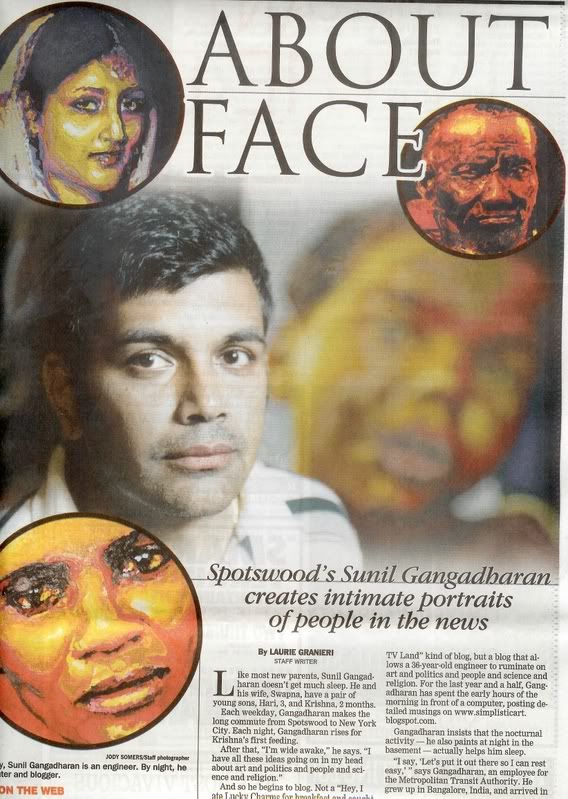
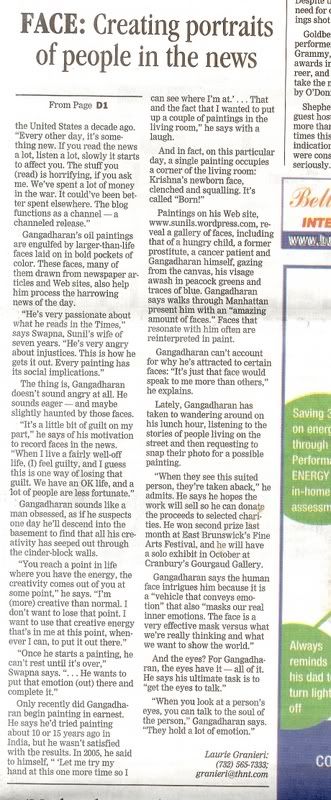
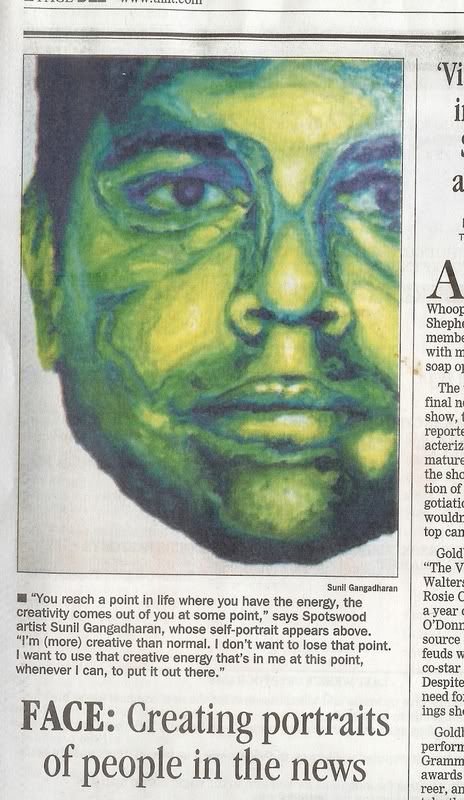
Newspaper writeup on my art...

Carrying on the shameless bit of self promotion started off here, I was happy to find a nice writeup about my art and a bit about our family in today's issue of the Central Jersey newspaper Home News Tribune.

Newspaper article:

- Front Page teaser.
- Page 1.
- Page 2 and a picture.

The online article without pictures here.