Every once in a while an artist toils in relative obscurity only to be discovered after her/his death. After their death, the world 'finds' out more about the person and their art, launches into a 'closer reading ' of the works through exhibitions and such and suddenly finds that there is more, much more to the individual - who has since passed on. The art and life of Marvin Franklin is an example of such an unfortunate circumstance.
“
Art saved my life” - Marvin Franklin (1952 - 2007)
Artist and New York City Transit track worker Marvin Franklin
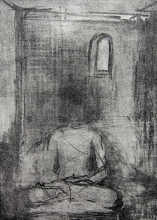
lost his life in the line of duty on April 29, 2007 while working the night shift as he had for twenty two years. He leaves behind a wife and three children. The artworks (drawings, prints and paintings) are set in the subway system where he spent much time as both an employee and a commuter. Most of the artworks depict homeless people. The artworks are on display until the end of March at the
New York Transit Museum in Brooklyn.
The artist was once homeless himself.
From the blurb accompanying the exhibition
: The night shift was 11PM to 7 AM. After work he would get on the F train at Jamaica/179th Street, the end of the line in Queens, sketch book in hand, and draw his fellow passengers all the way to 57th Street in Manhattan where he went to school. For more than a decade he attended school at the Art Students League from 9AM to noon. After school he would get back on the F train and sketch some more on his way home. With twenty two years on the job, he was three years away from retirement. Then he hoped to teach art, exhibit his work to raise awareness about homelessness and sell his artwork to raise money to help people in need.
The following
lines from a New York City artist in response to an
article that covered Marvin Franklin’s death is instructive of the close association between art, success in the artworld and money resulting in only a select few reaching the top.
Franklin’s tragic death also highlights the polarization and inequality that has intensified over the past several decades in the art world no less than American society as a whole. In today’s highly competitive commercial art market, in addition to the time and concentration required to develop one’s craft and artistic vision, artists must invest considerable resources in promoting their work. If they are lucky enough to get an exhibit, they are often asked to pay all expenses related to advertising, delivery and installation of their artwork, which can run into hundreds, even thousands of dollars. Salaried positions for artists are rare; according to the Bureau of Labor Statistics, the median annual wage in 2004 was only $37,000. Sixty-three percent of artists list themselves as self-employed and their income is even more precarious. An artist lucky enough to find gallery representation must give 50 percent of the proceeds to the gallery, and so even an artist who does reasonably well, and sells $50,000 worth of work per year makes only $25,000, and that is before taxes.
The distortion that such pressures exert on the type of art produced, as well as the experiences and outlook that finds expression in today’s artwork is extreme, and mostly deleterious. Very few artists like Marvin Franklin are able to develop to the fullest of their abilities or even, literally, survive under such conditions. The result is an alienation from art by broad masses of people and a general cultural impoverishment.
 Drawings reproduced from sketchbooks (2004 - 2007)
 Untitled, Watercolor on paper
 Untitled, Watercolor on paper
 Untitled, Watercolor on paper
 Late Rider, etching
 Subway passenger, Etching
 Late afternoon. Jamaica Bay Wildlife Refuge. Brooklyn, NY


