Thursday, August 09, 2007

On the Industrial Revolution - another weary theory

In a book titled 'A Farewell to Alms', due out next month from the Princeton University Press, Dr. Gregory Clark, an economic historian with the University of California, Davis believes that the Industrial Revolution - the surge in economic growth and activity that heralded the rise of affluence in England in the 1800’s - happened because of a change in the attitude and nature of human beings and not primarily because of the development of efficient and stable social institutions (as is more normally accepted). Review of the book in the Times here.

Graphs scanned from the New York Times (click on image for clarity)

Essentially the gist of his argument can be whittled down to the following: The rich people in England reproduced more, their progeny had a greater chance of success in living out their lives, they slowly were acclimatized to the principles of a less violent, less brutal form of social intercourse, sowing the seeds that produced the industrial revolution. Then you might ask, what about the rich in similar parts of the world like China, India and Japan. Out here, Dr. Clark has drummed up records to prove that the rich were not as fertile as the rich in England because of recorded lower than normal rates of fertility among the affluent in the Asia’s which means that the Malthusian laws of a steady state population remained in vogue in these countries leading to no revolution but a steady state of agrarian stasis in these areas.

The basis of Dr. Clark’s work is his recovery of data from which he can reconstruct many features of the English economy from 1200 to 1800. From this data, he shows, far more clearly than has been possible before, that the economy was locked in a Malthusian trap _ — each time new technology increased the efficiency of production a little, the population grew, the extra mouths ate up the surplus, and average income fell back to its former level. The tendency of population to grow faster than the food supply, keeping most people at the edge of starvation, was described by Thomas Malthus in a 1798 book, “An Essay on the Principle of Population.” This Malthusian trap, Dr. Clark’s data show, governed the English economy from 1200 until the Industrial Revolution and has in his view probably constrained humankind throughout its existence. The only respite was during disasters like the Black Death, when population plummeted, and for several generations the survivors had more to eat.
Sir Lawrence Alma Tadema (British, 1836 – 1912), Bachanal, 1871, Oil on canvas, 16” X 32”


Generation after generation, the rich had more surviving children than the poor, his research showed. That meant there must have been constant downward social mobility as the poor failed to reproduce themselves and the progeny of the rich took over their occupations. “The modern population of the English is largely descended from the economic upper classes of the Middle Ages,” he concluded.As the progeny of the rich pervaded all levels of society, Dr. Clark considered, the behaviors that made for wealth could have spread with them. He has documented that several aspects of what might now be called middle-class values changed significantly from the days of hunter gatherer societies to 1800. Work hours increased, literacy and numeracy rose, and the level of interpersonal violence dropped. It is puzzling that the Industrial Revolution did not occur first in the much larger populations of China or Japan. Dr. Clark has found data showing that their richer classes, the Samurai in Japan and the Qing dynasty in China, were surprisingly unfertile and so would have failed to generate the downward social mobility that spread production-oriented values in England.
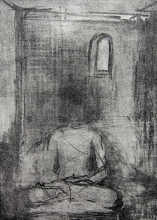
Juan O’Gorman (Mexican, 1905 – 1982), Ruinas de la Torre de Babel, ink and pencil on paper, 22” X 13”

No doubt, the book makes you think. In addition, the New York Times tells us that he has drummed up reams of sufficient research and background investigations to support each of the premises in the book. I am definitely going to get this book when it hit the stands in the hopes that it will provide clues on one of the enduring questions that I have not an answer to: The inability of Asian economies to produce any kind of an Industrial Revolution at about the same time (assuming that all of humanity progresses socially and culturally at about the same rate) and I hope this book sparks answers to some of these more vexing questions...

I do have a couple of issues with the arguments presented which I guess can only be answered by a closer reading:

Although not explicitly mentioned, it also seems that he does not seem to credit the Enlightenment and the 'age of reason' (1790's) as a major lubricant for oiling the locomotive of the industrial revolution...

Isn’t attributing a cultural tour de force like the Industrial Revolution to the mating practices of rich horny English peoples a bit too simplistic?

In a rhetorical side note, the argument that the rich people provided for the seeds (pun unintended) of the Industrial Revolution could be subverted by the right set of people (you know which set) to bolster the assumption that the rich should be taxed less such that they can use the excess income to invest and raise standards of living is strong....

Tuesday, August 07, 2007

Subprime musings

Unless you have been hiding out in the Kola well, you have most likely heard of the subprime mortgage fallout. The cunning stunts used by rapacious bankers in order to secure the bottom line is cannot be better illustrated than in a story I read in the Times recently.

Two years ago, when the housing market was roaring along, I called a mortgage broker on the West Coast and asked for some help. I told him that I wanted to interview some recent home buyers who had taken out an adjustable-rate mortgage — one of the big drivers of the boom — and he was nice enough to pass along a short list of names. One of the buyers was a business consultant in her 40s. She told me about her charming new house and the fact that she expected it to be a good investment, even if it had cost a bit more than she wanted to spend. Then I asked about her adjustable-rate mortgage. “I don’t have an adjustable rate,” she said. Confused, I called the broker again to see what was going on. A little while later, I got a sheepish e-mail message from him explaining that her loan did, in fact, have an adjustable rate. She just hadn’t realized it.


The bad stink of foreclosures due to the subprime mortgage meltdown raised by so many people living on the fringes who might have scrapped together just enough to make their minimum payments based on a scrupulous calculation of payments that depend on tenuous connections to ones employment is only about to get worse as the following warning presages.

The peak month for the resetting of mortgages will come this October, according to Credit Suisse, when more than $50 billion in mortgages will switch to a new rate for the first time. The level will remain above $30 billion a month through September 2008. In all, the interest rates on about $1 trillion worth of mortgages, or 12 percent of the nation’s total, will reset for the first time this year or next. A couple of years ago, by comparison, only a marginal amount of mortgage debt — a few billion dollars — was resetting each month. So all the carnage in the mortgage market thus far has come even before the bulk of mortgages have reset. “The worst is not over in the subprime mortgage market,” analysts at JPMorgan recently wrote to the firm’s clients. “The reason for our pessimism is that loans originated in late 2005 and all of 2006, the period that saw peak origination volumes and sharply decreased underwriting quality, are only now starting to reset in large numbers.”


Isn’t it about time for our banks and responsible bankers to stop screwing the gullible?

The great subprime mortgage domino - in three easy graphs

Rene Magritte, 'Le science des Reves', Gouache and colored crayon on card, 12" X 16" c. 1944

Farewell to a literary journal

Parnassus is finally closing shop. Herbert Leibowitz, literary critic and former college professor has thrown in the towel on Parnassus, the poetry journal he founded in 1973.

What has distinguished Parnassus has been a commitment to intelligence and beautiful writing, prose designed not for academics or even for poets but for the mythical common reader beloved of Samuel Johnson and Virginia Woolf. At a time when the world of poetry is full of coteries, back-slapping and back-stabbing, friends reviewing and awarding prizes to friends, Mr. Leibowitz and his young co-editor Ben Downing, who came to the magazine after a stint at Columbia's MFA program, insist upon passion, honesty and clarity. Like all good editors, they are curators, assembling things and people they like into interesting groupings (issues on Poetry and the Movies or Words and Music, for instance).
Volume 30, the big last issue, will come out later this year.

Monday, August 06, 2007

In gun we lust

Family picture: Rafael, with his wife, Cathy, and daughter, Victoria, and dogs Romulus and Remus


An interesting photo audio gallery on Newsweek here on gun ownership in America.

Law: The Second Amendment states "A well-regulated Militia, being necessary to the security of a free State, the right of the people to keep and bear Arms, shall not be infringed."
Statistic: Average number of annual gun-related deaths in the U.S. has fallen in recent years, but the total remains at more than 30,000.

Update: In addition to the daily reminders in the news as regards people being mowed down by guns due to the relatively easy access to the same, I was reminded of its pernicious effects a little more when three teenagers were shot down execution style in Newark (about half hour from our home). They were just lined up against the wall and shot in the back of the heads. You know, guns just make the dirty business of killing a lot easier. You do not have to look in their eyes.

Nature Art


The leafy seadragon is a cousin of the seahorse. I liked this picture a lot for the abstract forms that nature has artfully evolved to pay homage to artifice and camouflage - the only way by which this foot long creature can escape roving predators.
Note: Ripped from my National Geographic, Nov 06' print edition

Europe Envy

A new map of the world with all the new discoveries by Capt. Cook and other navigators ornamented with the Solar System, the eclipses of the sun, moon and planets Published as the act directs Aug 1st 1799 No 41

It is amazing how you tend to accept things for what they are and suddenly on a Sunday morning things seem to appear different and prejudiced. At school in India, I remember continents being defined as follows: "Continents are large, continuous, discrete masses of land, ideally separated by expanses of water" and there were 6 of them North America, South America, Antarctica, Africa, Europe, Asia, Australia. Like most other schoolchildren, I accepted the facts without question or analysis.

I was teaching continents to my son over the weekend, and suddenly I realized that the definition of the ' continent’, does not seem to fit Europe.

Going by the fact that the landmasses need to be large, separate and discrete, Europe just does not count as a continent. I wonder why we keep propagating myths like these even in modern times when it is woefully clear that it was originally devised as separate continent to maintain differences between the conquered Asians and the conquerors...

Have you thought of this at times? How many times have you seen ancient prejudices silently passed onto our children oftentimes without any additional thinking on our part...

Jules Didier (1831 - 1892) 'An Exotic Visitor', Oil on canvas, 32" X 25"

Thursday, August 02, 2007

Painting Post: A Decay Darkly

Title: A Decay Darkly

Medium: Oil on MDF

Size: 40" X 48"

Original Emerging...


Mika Yokobori, 'Blood Exchange', Acrylic on canvas, 65" X 72", 2006 - 7


Mika Yokobori is showing at Long Island City's Sub Division art in a group show titled Out of Me, Out of You.

Rothko power

We manage to dutifully TiVO all episodes of Simon Schama’s Power of Art to try and understand the power of art as Simon makes a case for it through the lives and works of artists like Van Gogh, Picasso, Jacques-Louis David , Turner et. al..

I liked his take on the majority of the episodes so far and it taught me a lot about art history (of which I have no formal instruction). It was with a lot of anticipation that I awaited his take on Mark Rothko (Latvian-born American Abstract Expressionist Painter, 1903-1970), but after seeing it yesterday, I realized that I still did not understand nor have a better appreciation for Rothko’s works. I still did not see in it what Simon and lot of others saw…

Often, with the additional psychological layering of the life of the artist on top of the painted canvas, the work tends to take on additional sensibilities that appeal to our senses and we seem to get a better maturity for the artist and the represented work… Even after sitting through an hour of Simon talking about Mark Rothko and his works, I did not get it..

It must be me…

The following excerpt is from an excellent article on art and synesthesia… An interesting read.

Rothko's horizontal divisions of soft floating colored spaces are an invitation to enter into the depth of the color fields, and to become totally saturated with them. The undefined background envelops the viewer and evokes a spiritual feeling of infinity. The painting has an almost breathing energy. Because of the luminous quality, the colors seem to move back and forth, as if it were another living presence. Rothko created his own biology of art. By the layering of one experience over another, Rothko's paintings seem to aspire the emotional condition of music, suspending sound in color, by radiating visually as silent music. The sensibility of the color is real and abstract at the same time. Rothko himself felt that the works could express emotions associated with universal themes such as tragedy, ecstasy, and the sublime. In this paintings, Rothko meditated on how the origins of life could function as a metaphor for the origins of consciousness.


Note: Mark Rothko’s real name was Marcus Rothkovich. The name change and shortening to a more convenient Americanized form had me thinking of the following excellent op-ed piece in the NYT yesterday.


Work in progress

It is rarely that I post work in progress here, but I was compelled to record this state of my current painting here because it represented - "a halfway house where calling it complete at this point of time may make it complete, yet it seems so full of additional possibilities that you feel compelled to paint the unpainted areas and complete it"...

Yes, an in between trishanku state, but not in limbo...

Wednesday, August 01, 2007

That falling feeling

Every once in a while, the officials in charge of running and protecting NYC seem to get a bit overzealous with respect to protecting gothamic denizens… It seems to barreling through a list of new draconian laws that will prohibit photography in this great city altogether.

Read more here (pdf alert!) but some winning excerpts of the proposal are here…

The following activities require that a permit be obtained beforehand:

(i) Filming, photography, production, television or radio remotes occurring on City property that uses vehicles or equipment

(ii) Filming, photography, production, television or radio remotes occurring on City property, involving an interaction among two or more people at a single site for thirty or more minutes, including all set-up and breakdown time in connection with such activities

(iii) Filming, photography, production, television or radio remotes occurring on City property, involving an interaction among five or more people at a single site and the use of a single tripod for ten or more minutes, including all set-up and breakdown time in connection with such activities.


Already there is talk that the fulcrum of the art world is slowly shifting away from the city to London and places of the same ilk, this will make sure that the process is accelerated…


Georg Baselitz, 'Fingermalerei I - Adler', Oil on canvas in artists frame, 78" X 52", 1971 - 72

Photo Haiku

To enjoy a good picture is a pleasure. To enjoy good poetry is also a pleasure. When the both are combined, the senses are pampered. Steve Durbin, a physicist turned photographer over at his website combines a bit of both (photography and haiku) to tease your senses in his series ‘Sourdough Trail'.

Be sure to check out his other series also in particular the narrative behind Anasazi Places and the abstraction behind Patina.

dry fountain
cherry blossoms fill
a stone frog's mouth

- ferris gilli

Tuesday, July 31, 2007

Chelsea Crawl - Part II

After getting a quick bite to eat, I popped over to Jeff Bailey Gallery. The gallery itself was a really small room tucked away on the second floor of a nondescript building in Chelsea… But, the trek was well worth it. ‘Awakened in the Peaceable Kingdom’, an exhibition of new drawings and sculpture by Jon Rappleye is a sight to behold.


Jeff Bailey, 'In the quiver of the kingdom', 2007, Acrylic on paper, 40" X 51"

“The exhibition’s title is inspired by Edward Hicks' (1780 – 1849) series of paintings, Peaceable Kingdom, where the worlds of nature and humankind coexist symbolically in a peaceful idyll. Hicks’ vision was reverent and hopeful, but tempered with concern for the darker and destructive impulses of both animal and man. Rappleye’s drawings feature abundant and extraordinary groupings of animals, birds and plant life. There are no humans. Birds and animals are combined into new, unfamiliar creatures.”

These renderings on paper have been masterfully executed and most of them left me staring into the detail for a long time trying to decipher the inner meaning behind a lot of the representational forms. Of course, having the artist there to walk you through a lot of the paintings would have helped immensely, but it does seem that Rappleye is obsessed with adding a blind owl and a large hairy rabbit in almost all his paintings. I guess the owl represents some sort of continuity in this post industrial landscape. I also did not understand why he did not include any humans in the supposed idyll of a peaceable kingdom if the reference to Ed Hicks is so strong. Strains of a post industrial Thoreau was also heard in my mind eye. All of these unanswered questions still did not stand in the way of his technique – a very original and striking artist whom I highly recommend. I have a funny feeling Chris Reiger would be interested in this sort of thing… I could be wrong here.

“This is Jon Rappleye’s second exhibition at the gallery. His solo exhibition, Out of the Silent Planet, is on view at the Jersey City Museum, New Jersey, through August 12. Upcoming solo exhibitions include, Strange World, at the Salina Art Center, Salina, Kansas (fall 2007) and the Clough-Hanson Gallery, Memphis, Tennessee (early 2008).”


Jeff Bailey, 'Nightwood Bloom', 2007, Acrylic on paper, 42" X 87"

Finally I trekked up all the way to the western end of the island in Chelsea to get to Point of View gallery. I went there purely because I have an enduring interest in human faces and the photographer Matt Hoyle seems to have masterfully captured a whole host of them in various poses of striking emotive power. The name of the show is Icebergs and the name refers to a certain winter swim club where individual members gather at a designated time in the winter to what else – swim…
Matt has managed to masterfully photograph the members of this club in a early morning light with a natural frozen gleam that seem to permeate his HDR enhanced shots. Yes, that is right, I have a fair idea that he uses the techniques behind HDR photography.
Matt Hoyle, 'John'
“Every artist needs to find his or her voice and if I had to describe mine, it would be of quirky empathy that I feel for my fellow human. From the humorous to the heartfelt, I try to look deeper within the subjects I photograph to draw something out that is unique. In doing this, I try to let you look a bit deeper too. What has always interested me as an advertising creative has been stories. Beyond the pure aesthetics of a really nice photo I find what makes me look longer is the hint of a story in the person. And the diversity of subcultures within any society interest me. The fine detail of character in each one that makes them stand out from the rest. I hate wallpaper people, the pretty plastic set in every fashion magazine. For me the interest lies in the raw colourful humanity of us all. People say that they can see through my shots a unique closeness I have with each subject. It really brings me joy to hear this, as that is exactly how I feel when I'm shooting. Photography has been a sort of ticket, I believe, that lets me into the lives of so many I otherwise wouldn't have even known about.”

On looking at these photos in the gallery, I believed that his reliance on HDR photography alone may not take him too far (look at some of the superlative images of HDR enhanced photography on Flickr and you will see what I mean). Of course, I was proved wrong when I went got back and decided to visit his website. It seems to be a treasure trove of narrative pieces waiting to be discovered. He does not disappoint.

Matt Hoyle, 'Vladimir'
I remember feeling a strong urge to paint these faces on walking out of the gallery. The emotions and character depicted on these faces were very strong and I was very moved by the people depicted. I might try and paint them in the coming months.

Monday, July 30, 2007

Chelsea Crawl - Part 1

I went to four shows in Chelsea last week and wanted to share my thoughts details here.

Daneyal Mahmood Gallery is showing the Italian artist Davide Cantoni in a show titled 'Burn Drawings' and it sure is hot (and it was a revelation). Davide has managed to use a magnifying glass, concentrate the sun’s rays and burn vellum in a detail that needs to be seen. The rendering coalesces into a hazy, nether world scrawl that has you thinking about the social issue depicted as well as the technique employed in creating these works.

Most of the works are small scale but the one that blows you away is ‘Luna’ – a square work 6 feet X 6 feet has you thinking of the lunar surface and other worlds rendered with cunning detail on six individual pieces of vellum.

"This exhibition includes Mr. Cantoni's new drawings including his largest to date "Luna" and his first video "Sol," an animated rotation of the sun rendered as burned drawings. Setting up Sun and Moon at either ends of the gallery Cantoni activates the space in between these two works as the stage to present us with images from our daily existence. Everything laboriously burned, this rite of fire, exposes us to these images for a second time this time demanding more attention. It is this active act of looking, that the artist is interested in engaging us in.”

The paintings (burnt vellum drawings?) has to be seen for someone to feel and be engaged with the work – no image will do justice to his pieces. The fragility of the vellum also hints at some of the ethereal psychological underpinnings behind Davide’s art.

SUN - paper burnt using sunlight

'Looters - Baghdad' (Not part of the show)

I was chatting with the assistant director of the gallery when I caught sight of this huge canvas (must have been at least 9 feet in height) in her inner office. On shamelessly enquiring about it a little more, I found out that Daneyal Mahmood Gallery will be exhibiting the work of Farhad Moshiri in October. His large scale oil/acrylic canvases with Arabic calligraphy are a sight to behold and I will very much be going to his opening in a couple of months from now.

The texture resembles cracked ice (as if millions of ice particles were clinging onto the surface of the large vase). He is said to crinkle up the canvas on completion. Not too sure how he does this in such a predictable way but the results scream randomess and controlled. The gallery was kind enough to send some jpegs my way and I have posted it here…

Farhad Moshiri, 'Gray Target', 106" x 72” . Oil and acrylic on canvas

Farhad Moshiri, 'Brown and Pink Urn', 60" x 42” . Oil and acrylic on canvas


Farhad Moshiri, Brown and Pink Urn - detail

My second visit was to Bodhi Art where a Paris based artist of Indian origin Jayashree Chakravarty was having her show titled ‘Where The Sand Meets the Sky’.

“Chakravarty creates elaborate maps of consciousness. The pictorial language of her works reflects her deepening inquiry into the secret life of memories, their pervasiveness and intensities. Disparate worlds are layered together with great panache – the effect of pigments, texture, personal and historical connotations, and the imagistic registers are orchestrated together in a magical network that creates a telling language of associations.”

I was not too very impressed. A couple of pieces that stand out are posted here, but for the most part were insipid renderings of ducks, sparrows, beetles, butterflies, spiders and fish over a background of acrylic/oil worked finely with a palette knife. The problem with these works was that all of them were much too similar and I got bored after looking at the first three pieces. They were fairly expensive too....

Jayshree Chakravarty, 'Untitled', acrylic and oil on canvas 72" X 70" 2006-2007


Jayshree Chakravarty, 'Untitled', acrylic and oil on canvas 72" X 54" 2006-2007

I will post my travails/travels to a couple more galleries tomorrow.

Ernst Ingmar Bergman (1918 - 2007)

Sunday, July 29, 2007

Newspaper writeup on my art...

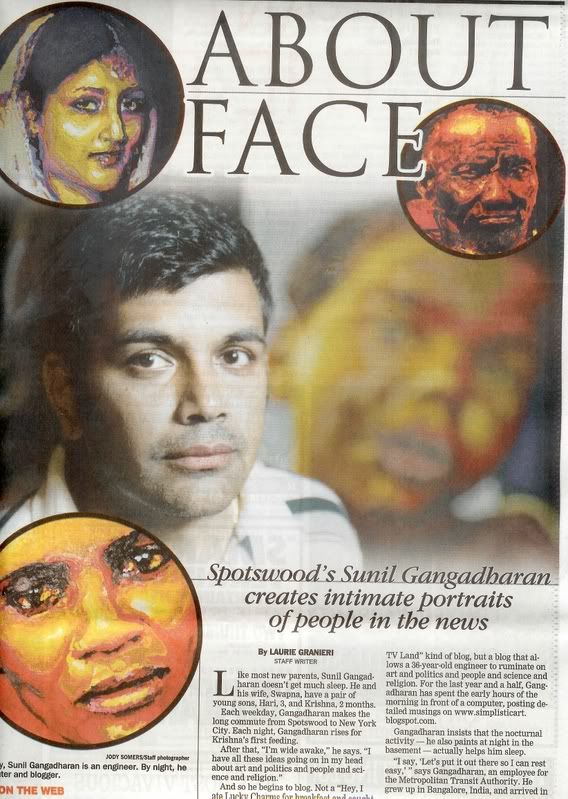
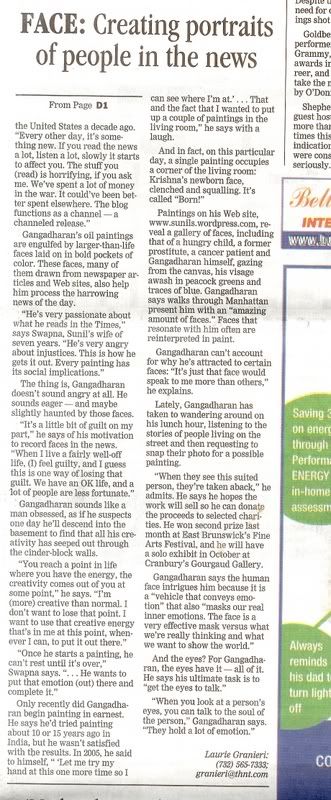
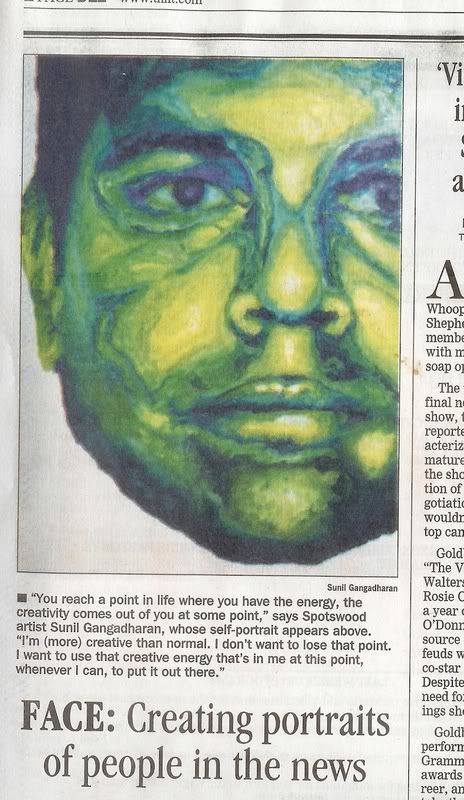
Carrying on the shameless bit of self promotion started off here, I was happy to find a nice writeup about my art and a bit about our family in today's issue of the Central Jersey newspaper Home News Tribune.

Newspaper article:

- Front Page teaser.
- Page 1.
- Page 2 and a picture.

The online article without pictures here.

Friday, July 27, 2007

Growth - Boom - Bust

The New York Historical society has a superb exhibition going on at their sprawling museum close to Central Park. In an exhibition titled “Nature and the American Vision: The Hudson River School at the New York Historical Society”, the museum has managed to roof paintings from the likes of Asher B. Durand, Albert Bierstadt, Gil Stuart, George Henry Boughton, and Thomas Worthington Wittredge under its auspices.

The real reason why anyone around the area need to make it to this show is because they have shown Thomas Cole’s five work masterpiece "Course of Empire". This set of paintings has been compared to the creation of the Central Park.

The five paintings are:

"The Savage State" (hunter gatherers foraging under forbidding skies)
"The Pastoral State" (natives acquire temple and landscaping skills)
"Consummation" (nature overrun by classical architecture)
"Destruction" (the state is swallowed by tempests of smoke and fire)
"Desolation" (state - a rubble pile with decayed humanity)


Sitting on the shoulders of giants, see here for a description of Ed Ruscha's 'Course of the Empire' paintings at the 2007 Venice Biennial.

It is funny when you consider that the United States of today is in one of these states.

Which one depends on your point of view…

Gesso that I know...

Sometimes gessoing a board can be real fun. Think about it, you do not have to concentrate too much, just make sure that the gesso brush moves evenly in vertical or horizontal strokes and make sure the edges are evened out. Of course, it could also take a toll on your back if you are not too careful about the postures, but I try to stretch out every once in a while when I am at this..

The process itself at once it brings to mind Pollock sitting down over his canvases thinking about where to let go the next drip, only here you do not contemplate that much, of course you could get lost in the wavy patterns of thickly built up pigment the moment they form and then follow their evaporative course until they dry, but I don’t have that much time.


I tend to use a professional grade of gesso that I manage to get from the Utrect outlet store about half hour from our house. A couple of coats over two days will get the board or stretched canvas as smooth as a baby's bottom...


Like I apply the oil paints, I like to lay the gesso thick so much so that the ridges and furrows give the final painted-on surface a special texture that I enjoy very much. All said and done, it was well worth the effort. Now to slap these four pieces with some meaningful paint on is another matter altogether...

Thursday, July 26, 2007

Art and some Indian history

I am continually amazed at the amount that art can teach when it comes to history... This week I learnt something about the country of my birth – India.

I was surprised to learn that certain kingdoms in India were ruled by people from Africa. A lecture hosted by the Sundaram Tagore gallery in Manhattan last week focused on this very eclectic phenomenon that highlighted the fact that India was the only country outside of Africa where Africans ruled over non-Africans.


A 17th century Mughal style painting from Alwar represents more dramatically and with greater fiction the so-called house of Timur. Jahangir's figure forms the axis, around which are portrayed his eight ascendants, each contained in a medallion.


Detail of the above painting showing Jahangir shooting Malik Ambar through the head.

They originally came to India either as slaves or mercenaries and later (either through luck or circumstance became small time rulers in their settled areas). A couple of incidents that were highlighted at this lecture were as follows:

In 1486, a group of African mercenaries fought the Sultan of Bengal and eventually won the throne for a good 100 years. The descendants of this class of people came to be known as the Sidis.

“After their conversion to Islam, the African freedmen of India, originally called Habshi from the Arabic, called themselves Sayyad (descendants of Muhammad) and were consequently called Siddis. There are identifiable Sidi communities in Gujarat, Maharashtra (around Bombay), and Hyderabad. Most of the Sidis live in Gujarat, a state in western India. Jambur, a village in the Gir forest is an exclusive Sidi settlement. The Sidis here have retained their lineage of music and dance – their only link now with Africa. A smaller group of Sidis lives in Junagadh, a town not far from Jambur. According to Professor Amy Catlin, an ethno-musicologist from UCLA, who is making a special study of Sidi culture, "In Gujarat, affinities with African music include certain musical instruments and their names", she says, "and also the performance of an African-derived musical genre called "goma".”

The rise and fall of Malik Ambar between 1560 and 1620 was the crowning achievement of Africans in India. This former slave after being freed slowly collected a small army and managed to rule the Nizam Shahi kingdom in central India with relative prosperity (so much so that the Mughals who ruled in the north were so incensed that they produced artwork that showed Jehangir taking archery pot shots at Malik Ambar's head). It is said that the revenue system that Malik Ambar developed when he ruled the kingdom lasted till the early days of independence (1940's) from British colonial rule.

Painting of an African Indian merchant - circa 1600

Indian painting depicting African Indian

Additional references:

- A Social History of the Deccan, 13001761: Eight Indian Lives (The New Cambridge History of India) (Hardcover)

- Architecture and Art of the Deccan Sultanates (The New Cambridge History of India) (Hardcover)

Of spools and reels - an interesting quote

Mathias Grünewald, The Temptation of Saint Anthony, 1515


“In the States, it’s like we’re in the last half of the third reel of a three-reel movie, and all we have to do is decide we’re done here, and the credits come up, and the lights come on, and we leave the theater and go on to something else," he said. "Whereas out here, you’re just getting into the first reel of five reels,” he added, “and as ugly as the first reel has been, the other four and a half are going to be way, way worse.”


--US Ambassador to Iraq Ryan Crocker, as quoted in the New York Times

Wednesday, July 25, 2007

Little bit of self promotion

I have been a bit busy with work at work, work at home and some miscellany. Have not had much of a chance to post here but a couple of things to look forward to are as follows:

On Sunday, the central New Jersey newspaper (Home News Tribune) is doing a story on my art and a bit about me. The interview was revealing in and of itself for me as well as the reporter (maybe I should talk about my art more often) - it clarifies things in your mind about the work you undertake... If you get your hands on this newspaper by any chance, do not forget to check the story out. They have an online story as well (is what the reporter told me)...

Also, I have been conformed for my first solo exhibition at the Gourgaud gallery in Cranbury, NJ. The show will run for the whole month of October 07'.
I will post more details as and when they turn up.

I have a couple of pictures that my son and I took yesterday afternoon in our garden.
Enjoy.


Gossamer


Burnt Umber

Monday, July 23, 2007

DC Diary

We spent the weekend in Washington D.C. The Hirshhorn museum was closed when we got there at dusk, but that did not stop us from enjoying some of the sculpture outside and taking some pictures.

'Clouds over Congress (pun unintended)'


'Washington Monument', Robert Mills, marble granite and sandstone, 555 feet high, 1884

Mark di Suvero, 'Are Years What? (for Marianne Moore)', welded steel I beams, 1967

Gaston Lachaise (1882 - 1935), 'Standing Woman', Bronze, conceived 1932 (cast 1981)

Jean Arp, 'Evocation of a Form: Human, Lunar, Spectral', Bronze, conceived 1950 cast in 1957

Friday, July 20, 2007

Poetry

Andrew Wyeth, The Stone Fence, 1946, Tempera on panel, 25 X 18 in


Andrew Wyeth: “Tempera is a dry pigment mixed with distilled water and yolk of egg. I love the quality of the colors: the earths, the terra verde, the ochers, the Indian reds, and the blue-reds. They aren’t artificial. I like to pick the colors up and hold them in my fingers. Tempera is something with which I build - like building in great layers the way the earth was itself built. Tempera is not the medium for swiftness.

Note: Some critics dislike his work simply because it is so popular and appeals to people because it is representational in nature.