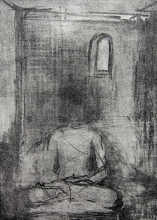
A sample of swirling thoughts in the minds of little Adams and Eves - a Poem
The Father,
he showed us a few tricks
every once in a while.
He lifted our frocks
he played with our shorts
helping us with the little mittens, amidst
gentle whispers to stay warm.
Even helped tie our laces,
after it was over.
His fingers seemed to glide
and hustle. Darting, furtive.
Everywhere.
God, it was confusing.
He said he loved us
and sometimes kissed us.
He often played pretend with us,
and, once in a while,
fucked us.
Yes, it did hurt
it hurt very much.
We thought it was part of liturgy.
A ritual. Part of our Sunday afternoons.
The sermons would also say;
learn to notice that silver lining (in every day things)…
The good Father would say that too – lovingly
and often.
We managed to find our bright spots here too.
The immediate pain was only fleeting, white hot,
infinite, yet, contained in place (not time).
After that, you get used to it.
Kind of like being whipped,
after the initial tear in your skin,
the subsequent lashes
are just consolation.
A perverse kind of consolation,
that the familiar is back (the numbing, a helper).
And don’t we all huddle to the familiar?
Like the flocks towards that good Shepard.
From here:
One out of five alleged victims of clerical abuse have been girls or women, according to a 2004 study commissioned by the U.S. Conference of Catholic Bishops and conducted by researchers at the John Jay School of Criminal Justice. But that disparity “may have less to do with the actual incidence of abuse than with the reluctance of women to come forward,” says Angela Bonavoglia, a Ms. contributor and author of the 2005 book Good Catholic Girls: How Women Are Leading the Fight to Change the Church. Bonavoglia believes the Church maintains a lingering blame-the-victim mentality toward girls and women. She has written that girls—particularly older ones—may be viewed with the biblical notion that they’re sexual temptresses—“little Eves”—responsible for enticing older men and consenting to “normal” relations. It’s much easier, then, for the Church’s male hierarchy to condemn the abuse of boys, since that’s seen as “homosexual behavior,” for which the Church offers blanket condemnation.
Showing posts with label drawing. Show all posts
Tuesday, April 22, 2008
Thursday, January 10, 2008
Tuesday, January 08, 2008
Political ceilings and women
A lot of us were recently privy to the lives of two women at the upper rungs of their respective political situations. Unfortunately, one of them is no longer with us. She was killed off by an assassin for daring to come back and stand for elections in a country trying to hide a poor record of individual rights and freedoms. The other woman is very much with us, struggling to re-assert her candidacy for becoming the leader of what is currently the most powerful nation. The former is of course, Benazir Bhutto and the latter is the redoubtable Hillary Clinton. It has been said in some quarters that the late Ms. Bhutto would have stood a very good chance of winning elections in her nation if she had been allowed to complete her course.
It indeed is a run of irony that in a predominantly male dominated nation (Pakistan) that is overrun with the vile nexus of corruption, terrorism and quasi dictatorship, a lady should stand a very good chance of winning the national polls, while the United States who trumpet things like equal freedoms for the sexes, low governmental corruption and a model of representative democracy, the leading lady should struggle so hard to even convince people that she indeed is electable and palatable. Oftentimes, I hear from colleagues back in India, who claim that India, Pakistan and Burma are much more pluralistic and inclusive than the United States given the fact that we are not able to muster a lady for high office.
However, reading a paragraph in a recent opinion piece in the Times written by Reason magazine editor Kerry Howley helps us get a better perspective of the seeming paradox. In her words:
Like it or not, the road to female advancement often begins at the altar. History books are thick with examples of women who broke political barriers because their family connections afforded them the opportunity.
If you’ve ever wondered why India, Indonesia, Myanmar, Pakistan and the Philippines seem readier to elect women than does the United States, here’s your answer: Societies that value a candidate’s family affiliation, and therefore have a history of nepotistic succession, are often open to female leadership so long as it bears the right brand. Benazir Bhutto, Indira Gandhi and Daw Aung San Suu Kyi, among many others, slashed through gender barriers on the strength of their family names. In the United States, where a poll last year found that 14 percent of people still admit they would not vote for a woman, nepotistic advancement for women in politics was most common early in the 20th century.
Social psychologists have found that women in leadership roles are typically seen as either warm, likable and incompetent, or cold, distant and competent. To be a strong, competent woman is to be something culturally unattractive, which probably says something about why few American women even aspire to political office. Worldwide, even popular female politicians — Margaret Thatcher, Golda Meir, Angela Merkel — are slapped with the moniker “iron lady.”
It does seem like there is more than what meets the eyes – that Asian countries are more tolerant of their women as long as they come with a corresponding rider - the lady in question advertises a certain branding (like a family moniker), the tolerance remains. In the United States, we have passed the age of branding (of course, it was very much the norm - as the essay shows). That does not mean that we stand free, high, moral and clear. We have not passed onto an age where ‘gender free’ competition (like that term or not) is the norm although we have made some amazing strides when it comes to ‘race free’ competition. Gloria Steinem in today’s Times puts it better:
Gender is probably the most restricting force in American life, whether the question is who must be in the kitchen or who could be in the White House. This country is way down the list of countries electing women and, according to one study, it polarizes gender roles more than the average democracy. So why is the sex barrier not taken as seriously as the racial one? The reasons are as pervasive as the air we breathe: because sexism is still confused with nature as racism once was; because anything that affects males is seen as more serious than anything that affects “only” the female half of the human race; because children are still raised mostly by women (to put it mildly) so men especially tend to feel they are regressing to childhood when dealing with a powerful woman; because racism stereotyped black men as more “masculine” for so long that some white men find their presence to be masculinity-affirming (as long as there aren’t too many of them); and because there is still no “right” way to be a woman in public power without being considered a you-know-what.
We will get there, but it sure is going to be a long hard haul on an uncertain road filled with crevices that promise a lot of stumbles as we get there... Oh, and by the way, India, Pakistan and Burma still have some catching up to do.
Note: List of Kerry Howley’s articles here.
It indeed is a run of irony that in a predominantly male dominated nation (Pakistan) that is overrun with the vile nexus of corruption, terrorism and quasi dictatorship, a lady should stand a very good chance of winning the national polls, while the United States who trumpet things like equal freedoms for the sexes, low governmental corruption and a model of representative democracy, the leading lady should struggle so hard to even convince people that she indeed is electable and palatable. Oftentimes, I hear from colleagues back in India, who claim that India, Pakistan and Burma are much more pluralistic and inclusive than the United States given the fact that we are not able to muster a lady for high office.
However, reading a paragraph in a recent opinion piece in the Times written by Reason magazine editor Kerry Howley helps us get a better perspective of the seeming paradox. In her words:
Like it or not, the road to female advancement often begins at the altar. History books are thick with examples of women who broke political barriers because their family connections afforded them the opportunity.
If you’ve ever wondered why India, Indonesia, Myanmar, Pakistan and the Philippines seem readier to elect women than does the United States, here’s your answer: Societies that value a candidate’s family affiliation, and therefore have a history of nepotistic succession, are often open to female leadership so long as it bears the right brand. Benazir Bhutto, Indira Gandhi and Daw Aung San Suu Kyi, among many others, slashed through gender barriers on the strength of their family names. In the United States, where a poll last year found that 14 percent of people still admit they would not vote for a woman, nepotistic advancement for women in politics was most common early in the 20th century.
Social psychologists have found that women in leadership roles are typically seen as either warm, likable and incompetent, or cold, distant and competent. To be a strong, competent woman is to be something culturally unattractive, which probably says something about why few American women even aspire to political office. Worldwide, even popular female politicians — Margaret Thatcher, Golda Meir, Angela Merkel — are slapped with the moniker “iron lady.”
It does seem like there is more than what meets the eyes – that Asian countries are more tolerant of their women as long as they come with a corresponding rider - the lady in question advertises a certain branding (like a family moniker), the tolerance remains. In the United States, we have passed the age of branding (of course, it was very much the norm - as the essay shows). That does not mean that we stand free, high, moral and clear. We have not passed onto an age where ‘gender free’ competition (like that term or not) is the norm although we have made some amazing strides when it comes to ‘race free’ competition. Gloria Steinem in today’s Times puts it better:
Gender is probably the most restricting force in American life, whether the question is who must be in the kitchen or who could be in the White House. This country is way down the list of countries electing women and, according to one study, it polarizes gender roles more than the average democracy. So why is the sex barrier not taken as seriously as the racial one? The reasons are as pervasive as the air we breathe: because sexism is still confused with nature as racism once was; because anything that affects males is seen as more serious than anything that affects “only” the female half of the human race; because children are still raised mostly by women (to put it mildly) so men especially tend to feel they are regressing to childhood when dealing with a powerful woman; because racism stereotyped black men as more “masculine” for so long that some white men find their presence to be masculinity-affirming (as long as there aren’t too many of them); and because there is still no “right” way to be a woman in public power without being considered a you-know-what.
We will get there, but it sure is going to be a long hard haul on an uncertain road filled with crevices that promise a lot of stumbles as we get there... Oh, and by the way, India, Pakistan and Burma still have some catching up to do.
Note: List of Kerry Howley’s articles here.
Labels:
drawing,
equality,
female political power,
feminism
Monday, January 07, 2008
At the MoMA last week
I was up at the MoMA last week to pay homage to the drawings of Georges Seurat. The exhibit closes today. Suffice to say, I was struck by the light emanating from his creations made simply by conte crayon on textured paper.
Of course, one could not miss the genius of Lucian Freud and Martin Puryear also on display. Mr. Puryear's work has to be physically seen for one to understand the complexity behind them. Images on the web (however detailed) do not convey the work involved.
Georges Seurat, 'A woman fishing', 1883, Conte' crayon on paper, 12" X 9"
Martin Puryear, 'Ladder for Booker T. Washington', 1996, Ash and maple, 36' X 22" X 3", Narrows to 1" at the top
Top view of some more Puryear's sculptures
Lucian Freud, 1994, 'Benefits supervisor resting', Oil on canvas, 63" X 59"
Assume Vivid Astro Focus, 'Wilza', 2003, Archival ink on acetate
Alexander Calder, 'Josephine Baker III', 1927, Steel wire
Jackson Pollock, 1947, 'Full Fathom Five', Oil on canvas with nails, tacks, buttons, key, coins, cigarettes, matches. This was one his first drip paintings later becoming his signature style. The title, suggested by Pollock's neighbor, quotes from Shakespeare’s The Tempest wherein Ariel describes a death by shipwreck:
"Full fathom five thy father lies
Of his bones are coral made
Those are pearls that were his eyes"
Umberto Boccioni, 1913, 'Unique forms of continuity on space', Bronze
Of course, one could not miss the genius of Lucian Freud and Martin Puryear also on display. Mr. Puryear's work has to be physically seen for one to understand the complexity behind them. Images on the web (however detailed) do not convey the work involved.
Martin Puryear, 'Ladder for Booker T. Washington', 1996, Ash and maple, 36' X 22" X 3", Narrows to 1" at the top
Top view of some more Puryear's sculpturesThis one below seems like a recent addition:
Assume Vivid Astro Focus, 'Wilza', 2003, Archival ink on acetateI also went around and prayed in front of some evergreen favorites.
Alexander Calder, 'Josephine Baker III', 1927, Steel wire
Jackson Pollock, 1947, 'Full Fathom Five', Oil on canvas with nails, tacks, buttons, key, coins, cigarettes, matches. This was one his first drip paintings later becoming his signature style. The title, suggested by Pollock's neighbor, quotes from Shakespeare’s The Tempest wherein Ariel describes a death by shipwreck:"Full fathom five thy father lies
Of his bones are coral made
Those are pearls that were his eyes"
Umberto Boccioni, 1913, 'Unique forms of continuity on space', Bronze
Labels:
drawing,
Modernism,
moma,
Oil Painting,
Sculpture
Friday, December 28, 2007
Drawing
Sunil, 'The United States of Adipose', Sumi ink on paper, 11" X 14"Note: The drawing is based on a photograph by Martha Casanave
Wednesday, December 26, 2007
Thursday, December 13, 2007
Friday, December 07, 2007
Thursday, November 29, 2007
Tuesday, November 27, 2007
Friday, November 16, 2007
Monday, November 12, 2007
Friday, November 09, 2007
Monday, November 05, 2007
Wednesday, October 31, 2007
Subscribe to:
Posts (Atom)


