Showing posts with label Art. Show all posts

Thursday, March 12, 2009

On hawking the gods

From a website selling prints of Indian gods. I hate the 'artsy' undertones implicitly embedded in the text...

During the late nineteenth century, India established a printing industry devoted to producing images of Hindu Gods & Goddesses. Go to India today and you’ll see them everywhere ( not the oldest, but prints from about the 1960’s on), in stores and restaurants, on taxi dashboards, tied to bicycle handlebars, even nailed to trees as parts of shrines. For Hindus these prints embody Gods, something of the essence or spirit of a God which is manifest in the world. During puja (daily worship) the God is invited to descend into its image and is treated as a guest. Offerings of fruit, flowers, or sweets are placed before these prints, prayers are chanted to them, incense are burned for them, and garlands of marigolds are hung around their frames.
India’s earliest color prints are lithographs printed from limestone blocks. Images were drawn by hand on as many stones as there were colors to be printed. These stones, each inked in one color, were then printed in succession. By the 1940’s this technique was replaced by the faster and cheaper photo-offset process used today.

They seem to have a gallery show at the International Print Center in NY next month...

Krishna with Gopis, Chore Bagan Art Studio, 1880’s

Saturday, March 07, 2009

Information technology and art - symbiotic?


From here: How is information technology changing the art world? The same way, you might argue, that it is changing everything else. It has put new tools into creative hands: there are artists making complicated impressionistic works using a paint application on their iPhones. There are artists working with G.P.S. mapping tools, hacking video games and creating art made from YouTube clips. Across the free-market souk of the Internet, more and more artists are trafficking in data, even as confusion about value and copyright proliferates.

And art in return is also changing information technology, by doing what art has done since the beginning, when the Babylonians first painted their palace walls, the Spanish royals first sat for a portrait or Gauguin first laid eyes on the South Pacific — by pushing the limits of our perception. I understood this most clearly visiting the Second Life work of an avatar named AM Radio, a thin, reedy guy who wears a thin, reedy top hat and in real life is a 33-year-old media designer who wishes to keep his exact circumstances private but who will say that he has an art degree and also a full-time job at I.B.M.

Tuesday, February 10, 2009

Some new digital work...


Too lazy to paint...

Friday, April 04, 2008

The audacity to mope

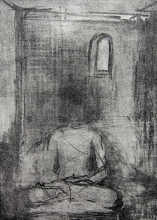
There has been a distinct dearth in the creation of any artwork from my side. I do not want to blame it on lack of time or devotion to family – although both of those factors do weigh in all the time (and gladly so). The fact remains that I am a little bored with painting faces (which occupied me for almost one and a half years) and am not too happy with splashing paint in abstract patterns (indulged myself this way for most of this year)... Guess one can call it moping around in a different sort of way. I am still exploring - not too sure where this will lead me - but am trying a variety of styles that aim to merge the ‘abstractional’ elements and representational forms. We have had a 15 X 6 foot canvas in the basement, primed, gessoed and ready for the paint – of course, it remains in its ever taut pristine whiteness – a silent spectator to dust mites and the diurnal rays of light that stream in from a couple of small windows on the basement walls. I have been doing a lot of studies and sketches on how best I go about the large canvas and here are three of them... Some of them are ink and graphite on paper whilst others were generated on a computer screen. Of course, not too sure if you noticed it in the tortured markings below, but an Anselm Kiefer gremlin bit me recently - although I have been feeling the distinct buzz of this contagious bug around my head for about two years now.


Thursday, December 06, 2007

Art and the ravages of time...

"Send me a postcard
drop me a line
Stating point of view
Indicate precisely what you mean to say
Yours sincerely wasting away
Give me an answer,
fill in a form
Mine for evermore
Will you still need me
Will you still feed me
When I'm sixty four"

So sang Beatles in their reflections on getting older. Among other things, getting older is something that none of us really relish – let alone getting to 64. Oftentimes, I wonder if I would still be doing art then, but then what else might be there to pleasure one's soul other than art, the love of my life and grandchildren. Talking about art, I also think about how one would look and perceive art as old age sets in. You might have a more refined, minimalist outlook or you might have a garish, overbearing persona on canvas – not too sure what might happen – sometimes no outlook at all – your senses dulled by a feeling of satiety after inhaling a life well lived…

Sometimes artistic outlooks/outputs (on canvas or otherwise) may be forced to proceed in a particular direction dictated by onset of illnesses or certain other maladies than as a conscious self-provoked decision to explore and nurture newer avenues. Whatever the case, the infirmities that befall one that consist of a kind that cannot be reined in and controlled tends to produce art that is often varied, richer (sometimes) or more diffuse - depending upon how you look at it. The case of de Kooning (depression), Monet (cataract) and others come to mind here. In this article on Art and Perception (provoked by reading a report on this individual's research reported in the Science Times), I write about how one might ascribe greatness to art based on past glories attained by the artist rather than appreciate art for what it is – in some cases a gooey mass of ill mixed colors or in other cases sheer resplendence – in both cases the result being a function of the infirmity that befell the artist.

Thursday, March 01, 2007

Ancient Art principles: Redux

I was recently reading a book by neuroscientist V.S. Ramachandran where he argues that Chola bronzes from ancient India were mocked at by the Victorian Englishmen as artistically primitive and unrealistic. They were unrealistic in the sense that the waist was too narrow, hips too wide and their breasts too large. They in fact decided that art like this was not art at all and labeled it primitive art. Professor Ramachandran goes on to say that some of the Victorians labeled the art thus based on prevailing standards of Western art (some of which was rooted in realism and stemmed from classical Greek and Renaissance art).

Today most people will readily tell you that most expressions of art is not really about realism and is not about creating a replica about what is out there in the world - rather it is a figurative way of communicating message(s) in an appropriate way to the viewer. He makes the assertion (a bit specious in my view) that the ancient Cholas really knew about this dictum long ago and that was the reason why they did not create ‘realistic’ statues but accentuated the hips and breasts of the goddesses such that they could abstractly communicate beauty of the female form (one among the many such subjects they tackled) to the common people.

On a related note, a finding by scientists at Harvard and Princeton shows that intricate decorative tile-work found in medieval architecture across the Islamic world appears to exhibit advanced decagonal quasicrystal geometry (mathematical concepts discovered by mathematicians and physicists just 30 years back). (Reported in the current issue of the journal Science)
“In their journal report, Mr. Lu and Dr. Steinhardt concluded that by the 15th century, Islamic designers and artisans had developed techniques to construct nearly perfect quasi-crystalline Penrose patterns, five centuries before discovery in the West. Some of the most complex patterns, called “girih” in Persian, consist of sets of contiguous polygons fitted together with little distortion and no gaps. Running through each polygon (a decagon, pentagon, diamond, bowtie or hexagon) is a decorative line. Mr. Lu found that the interlocking tiles were arranged in predictable ways to create a pattern that never repeats — that is, quasi crystals.” - excerpt from the New York Times (02/27)

This has oftentimes led me to wonder how many of our prevailing art movements could have roots in techniques practiced by our ancient ancestors. Have you come across any examples of this kind?
PS: The picture above is of Parvati, consort of Lord Shiva, circa 1000 AD, Tamil Nadu, India