

For the first time, Indians are standing up for their self interests (at least in economic matters) with a similar kind of ruthlessness that Americans have mastered in pursuing their interests. Good for them. As several readers pointed out, it is ludicrous to ask India to lower their emissions for at least another 25 years or until they become a developed nation. The current climate mess is caused by the current developed countries. They own it, so they should fix it. No use bullying countries like India which had nothing to do with creating this mess. They are not fools to bend over. The best that the developed countries can do with regards to countries like India is, give them green technology (for free) so that their development in the next 25 years will not be as dirty as that of the current developed countries. Some readers think that India's large and still growing population is a big problem. Obviously, they have not taken Econ 101. Large population is not a problem, it is an asset. However, the trick is to educate the population and make it productive. India, for decades after its independence from the British, has done a lousy job of educating its population, which became a liability. But it is changing now; in the coming decades, India's large, productive population is going to be its best asset.
Showing posts with label India. Show all posts
Showing posts with label India. Show all posts
Tuesday, July 21, 2009
Noticed...
I noticed this particular reader's comment in response to an article on the NYT covering Clinton's recent visit to India... (where she also happened to drop hints about India's so called 'emissions problem').

Thursday, June 11, 2009
Quotable
"Girls who choose to wear jeans will be expelled from the college, This is the only way to stop crime against women. Western dresses, including body-hugging tops and tight-fitting jeans, don’t indicate a disciplined atmosphere and attract comments from eve-teasers. We can’t overlook the safety of students. A dress code would check eve-teasing to some extent and also ensure that girls don’t waste their time selecting what clothes to wear," --- Meeta Jamal, principal of the Dayanand girls college in the city of Kanpur, India.
From here: Colleges in the Indian state of Uttar Pradesh said Wednesday that female students would be banned from wearing jeans and other Western clothes to halt sexual harassment by male classmates.
Sunday, April 26, 2009
Face

Rekha Kalindi, a 12-year-old girl living in Bararola, India,refused to get married when her parents tried to arrange one she wanted to stay in school. Her revolt, and those of two other girls in the region, have halted new child marriages in their rural region of West Bengal, India. The legal age for marriage in India is 18 for girls and 21 for boys. But arecent study published in the Lancet found 44.5 percent of Indian women in their early 20s had been wed by the time they were 18. Of those, 22.6 percent had been married before age 16, 2.6 percent before age 13.
More here.
Monday, February 23, 2009


Monday, October 06, 2008
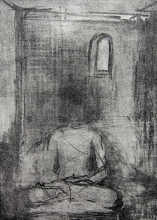
Painting Post

'Moksha II', Oil on canvas, 88" X 84", 2008

Continuing the series of paintings started here, I completed this last night. This took about three weeks to complete. I used a deep cadmium red hue and it seemed to contrast and overlay well over the un-stretched, non-gessoed canvas. I liked it.
Thursday, August 21, 2008
Photo
 'Happy in her own world', Color photo, Abhijit Nandi, Ripped from here.
A picture of an Indian paddy field worker coming home after a full day at the paddy fields won the Chartered Institute of Water and Environmental Management’s environmental photography competition.
Complete list of images here.
Saturday, August 16, 2008
Pictures from an Indian summer
Leafing through an album from a couple of years back I ran across these photos...


Friday, July 25, 2008
Linkage
'Why do women need men' is a thought provoking post about sexuality, marriage and Indian mores.
"why does she need another man?" - the implication was that she was after sex. It is sad that it is still not considered ok for a woman to want sex. It has always been accepted that men needed sex and so even if their wife died, they were encouraged to marry as soon as the grieving period was over. One of the arguments handed out for legalising prostitution is that a lot of men do not have the opportunity to marry or stay with their wives and they need outlet for their sexual desires. A woman's sexual needs are still frowned upon and they are quickly dubbed as nymphomaniac if they are open about their desires or needs.It is even considered something to be ashamed of. The number of children that a couple has had is hardly an indicator of a sexually fulfilling life.
"why does she need another man?" - the implication was that she was after sex. It is sad that it is still not considered ok for a woman to want sex. It has always been accepted that men needed sex and so even if their wife died, they were encouraged to marry as soon as the grieving period was over. One of the arguments handed out for legalising prostitution is that a lot of men do not have the opportunity to marry or stay with their wives and they need outlet for their sexual desires. A woman's sexual needs are still frowned upon and they are quickly dubbed as nymphomaniac if they are open about their desires or needs.It is even considered something to be ashamed of. The number of children that a couple has had is hardly an indicator of a sexually fulfilling life.
Friday, July 18, 2008
 Sunsetting religions
Monday, October 01, 2007
A relevant Indian movie at the NY film festival
 While the fact that two movies (The Darjeeling Limited and Outsourced) largely focus their attention on the Indian sub-continent might be flattering for a lot of Indians (currently playing in NY at the 45th New York film festival), most of the attention, headlines and ad dollars have been working in favor of the film by the famed wunderkind Wes Anderson who made 'The Darjeeling Limited'.
I might aver to say that the second of the two movies (Outsourced) might be more worth watching if you are into globalism, its effects and implications for the society at large.
Of course, if you are into quirky, enigmatic stuff (Trainspotting, The Big Lebowski, The Life Aquatic with… etc.) that you could lounge with in the company of friends with copious quantities of wine and the occasional experimental smoke - then the Darjeeling Limited might not be such a bore.
Some quick snippets about the movies:
The Darjeeling Limited
This shaggy-dog road trip, in which three semi-estranged brothers travel by rail across India, is unstintingly fussy, vain and self-regarding. The fraternal trio in “The Darjeeling Limited” — Francis, Jack and Peter Whitman — express, and perhaps construct, their personalities largely through their attachment to things. Francis has an expensive leather belt, which he tentatively offers as a gift to Peter, who cherishes a pair of sunglasses that once belonged to their father. The third brother, Jack, is a bit less of a commodity fetishist, though he does have a thing for the savory snacks served on Indian trains (and for the women who serve them).
Outsourced
At first it threatens to be just another fish-out-of-water story. Todd (the protagonist), being American, has no sense of himself as an American. He has an allergic reaction to Indian culture (embodied by the intestinal distress he suffers after eating local food). He is also taken aback by Indians’ emphasis on family ties and social obligations, and they in turn are politely aghast at Todd’s disconnection from his own relatives.
The film shows that individuals in every nation are nearly powerless before the global economy, a force that shatters tradition and compels people to think of themselves as self-interested free agents. This pragmatic point of view is articulated by Asha, who rhetorically asks Todd why it’s necessary for Indian call-center workers to pose as Americans while selling cheap junk made in China.
The last paragraph is just a classic. Both of the reviews are from the Times.
Thursday, May 03, 2007
Painting Post: Headload Worker from India
 Title: 'Coolie'
Size: 3 feet wide X 4 feet high
Medium: Oil on canvas
I completed this over the last three weeks...
Some context:
Headloading is a form of transport of goods and services that primarily involve a human being as the load bearer. The good or service to be transported is bundled and carried over the person’s head and is balanced by the individual while walking from one point to the other.
The weight of a typical head load carried by men and women around parts of India, Ghana and Lesotho is about 30 kilos. The average distance walked by some of these individuals is around 20 kilometers. Materials carried by the men and women range from water (primarily by women), bricks (men at construction sites) and vegetables (sold by men and women).
A short excerpt from a research article is useful (link posted below):
'The most striking feature that emerged from the research is the extraordinary amount of time and energy that the women expend to collect and transport water from the source to the home. Secondly, the primary means of transporting water is headloading. In addition, many villages continually face an acute shortage of potable water. Lack of access to safe drinking water, the effects of headloading on women's health, lack of access to adequate transport facilities and the burden of women's household responsibilities all have a detrimental effect on women's income earning abilities. The general welfare of the family suffers as a result'
Headloading is a particular issue for transporting water and other resources. The consequences of this are:
• It limits the amount of water women can transport at one time
• They are forced to make several daily trips to the water source
• They lose valuable time and energy in collecting water
• Household duties and children are neglected
• Women suffer chronic backache, foot pains and fatigue
• Skin and other types of diseases caused by lack of sanitation
• Young girls growth and development stunted
It should also be remembered that when the water levels are low, women spend much time and energy pulling the water up from the well. They may also have to wait in a queue at a standpost. The women expressed that they would like pipelines carrying water to their homes...
Links:
EVERYBODY LOVES A GOOD DROUGHT: Stories from India's Poorest Districts. By P. Sainath. New Delhi: Penguin Books. 1996. xiii, 470 pp. (B&W photos. ) Rs. 295, paper. ISBN 0-14-025984-8.
Travels with Sainath, Being an Indian Diary, First of Three Parts: Why Indian Farmers Kill Themselves; Why Lange's Photographs are Phony. By ALEXANDER COCKBURN
Wikipedia article on Palagummi Sainath
Non-Motorised Transport and its socio-economic impact on poor households in Africa Cost-benefit analysis of bicycle ownership in Uganda
India: Women, water, and transport in arid areas (IFRTD)
Subscribe to:
Posts (Atom)